chaplin

Thursday, March 05, 2015

Reality stands out like a sore thumb in the middle of something as fake as a football match

Swansea's Gomis collapsed during last night's game at Tottenham. There was no contact. He just went down as if poleaxed. Gomis has a history of similar fainting episodes. Following treatment, he was fine. He even wanted to carry on.

However you can see from Bentaleb's reaction in the picture how shocked the players were when Gomis went down and was suddenly surrounded by medical teams from both benches.

It always impresses me how quickly footballers know when something serious has happened on a football pitch and how instantly they drop all the play-acting. A genuine, potentially life threatening injury in the middle of a match is immediately apparent to all of them, no matter how far away they are from the action. They react with such shock that you'd think they were 12 year-old-boys rather than hardened athletes.

That's as it should be, of course. What's not as it should be is the pantomime of agony that takes up most of the average game and increases the nearer the top of the table the teams involved are placed. The intensity of faking in football has parted company with reality and can now only be compared to the death scenes in particularly overwrought operas. 

As in the opera, nobody's convinced about the injury being feigned but it's just sort of expected. As one former-pro pointed out recently, nobody's who's hurt rolls over three times. If the players who went down were hurt as much as they claim to be their team mates would be rushing to get them help, rather than rushing to get somebody else booked.

The sudden arrival of actual jeopardy, as happened last night at White Hart Lane and at the same place in 2012 in the far more serious case of Fabrice Muamba, only makes the fake variety look more fake.



Sunday, March 01, 2015

When rock stars played Scrabble

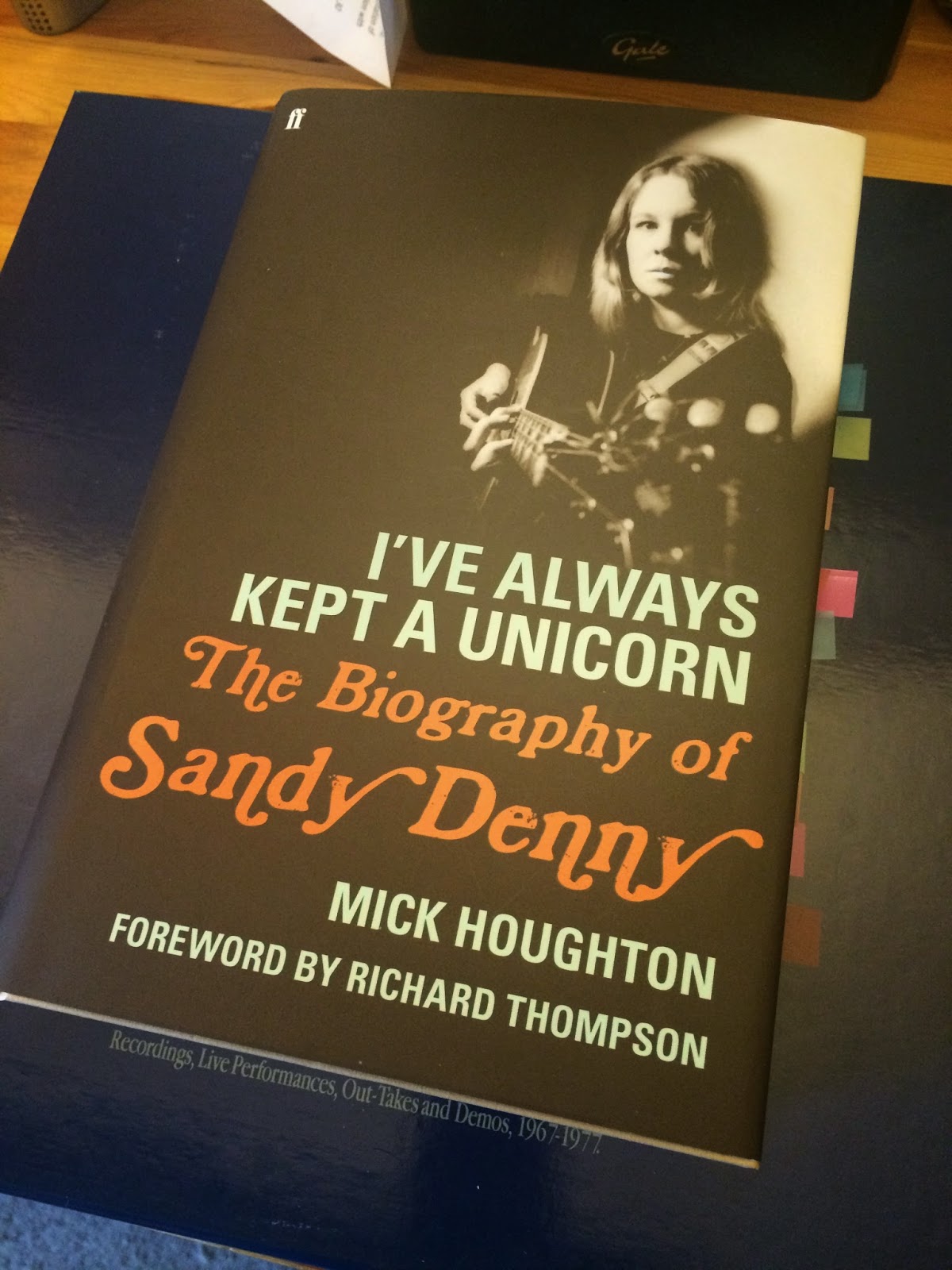
The more I look at 1971 the more it seems like a vanished world. I've Always Kept a Unicorn: The Biography of Sandy Denny by Mick Houghton is an oral history made up of interviews with people who knew her and worked with her and it's full of telling details of that same old world.

I've just been stopped in my tracks by one such detail.

Sandy Denny and Trevor Lucas liked to play Monopoly and Scrabble.

There they were, a swinging young bohemian couple with famous friends and a Chelsea address, and they chose to spend their time playing Monopoly. (Bruce Springsteen and Steve Van Zandt were doing the same at the same time over in New Jersey.) And when there wasn't a board around they invented word games. That's where the title of Fairport Convention's third album  "Unhalfbricking" came from.

This tells you one thing about life at the time and probably how that era came to produce so much vital music.

There wasn't a lot else to do.

In those days young, hip, long-haired people never watched television. They couldn't afford a set and there wasn't much to watch on it if they did.

Of course they lived full lives - drinking, socialising, fornicating, playing, plotting and all the rest that you might expect - but they didn't live with the low level distractions which are an inevitable by-product of plenty and progress. That is what made them so productive.

Next Monday, March 9th, Mark Ellen and I will be talking to Mick Houghton, who wrote the book, as well as Simon Nicol and Ashley Hutchings, who started Fairport Convention in 1967.

It's at the Slaughtered Lamb in Clerkenwell. It starts at 7:30 and is over by 9:00. You can find out more and get tickets here.


Friday, February 27, 2015

In praise of Bluetooth headphones

It was Johnnie Walker who got me interested in Bluetooth headphones. I bought the same Sony MDR-10RBT model as he did and I'm pretty pleased with them.

I have to listen to a lot of radio previews in a week to write about them for The Guardian. I can pair these headphones with phone, tablet, laptop or iMac and can then wander fairly freely while still listening closely. The signal starts to break up if you move too far away from the source but within reason the connection works very well.

If you've got them paired with your phone and you get a call while listening you can press a button on one headphone and immediately you're through. Not sure I'd use them if I was working in an office (might feel too much like a minicab driver) but at home they do the job.


Wednesday, February 25, 2015

Great advice for writers and editors from The New Yorker

I've no idea by what act of creative accountancy The New Yorker manages to keep going but I'm delighted it does. To mark the magazine's 90th anniversary they've published this podcast which features lots of the magazine's key people talking about how the magazine is written and edited.

It's full of good thoughts. The secret of editing is not to come up with the best article but to come up with the best article the writer can write.

I like the one about the editor who told James Thurber not to bother improving his drawing because "if you get any better, you'd be mediocre".

I also like the other one about the editor who when she wanted to be abusive would scrawl the word "poetry" on a proof.

I think she was also the one who said "if you can't say it clearly it doesn't exist".

Tuesday, February 24, 2015

Sometimes the kids aren't alright

I heard the head teacher of Bethnal Green Academy talking on the radio. This is the school attended by the three girls who've run off to join Islamic State.

He was at pains to assure everyone his school promoted values of fairness and tolerance. I don't doubt it. However I wonder whether some of his pupils were listening any more than we were back in the sixties when an earlier generation of head teachers lectured us about the value of self discipline and being smartly turned-out.

The Bethnal Green head's voice was the voice teenagers hear so often nowadays that they must imitate it behind their hands. It's the voice of the prevailing wisdom, the voice they hear on the radio all the time, the voice of public statements, the voice of everyone from vicars to pop stars, the voice of adults promoting peace and togetherness so insistently that a few of the people listening inevitably start to crave the opposite.

It was always the way. As Marlon Brando's character in the "The Wild One" said, "What am I rebelling against? What have you got?"


Saturday, February 21, 2015

When advertisers in newspapers knew where to draw the line

Looking through 1971 numbers of The New York Times, I'm struck by three things:

How much page real estate was taken up by ads in those days.

How much of the ad space was bought by the major department stores, the retailers, rather than the brands themselves.

How most of the ads were illustrated rather than photographic.


Friday, February 13, 2015

What Shakespeare thought about Twitter

Jon Ronson's piece about Justine Sacco, the woman whose life and career were destroyed by a tweet, is unsettling reading.

She's the PR who posted what was supposed to be a dry joke about AIDS while on a trip to South Africa. She got off the plane at the other end to find she had lost her job, broken her family's heart and was the number one target of a digital lynch mob, none of whom had heard of her a few hours earlier.

In tracing how a little local difficulty turned into an international mob in full cry, Ronson turns up the guy you might call the First Shamer. Sam Biddle ran a technology blog and had 15,000 followers so when he re-tweeted the item and pointed out that Justine was a PR, it was bound to get some traction. But he can't possibly have predicted the catastrophe that befell her.

Key line in the piece for me is "social media is so perfectly designed to manipulate our desire for approval". Justine thought she might be doing that with her first tweet. Sam knew he was doing that by re-posting the item.

It's funny, really. All these modern young media people with their carefully cultivated "take me as you find me" facades and underneath they're all like kids desperately trying to buy their way into the cool corner of the playground by knocking somebody else's cap off. (I went to school a long time ago.)

The language people use on-line to express their approval or disapproval of things people write is full of the language of the playground: they talk of  "take-downs", of "nailing it", of skewering and burning and otherwise having the last word.

What they're really trying to do is make a name for themselves by rubbishing somebody else's.

Shakespeare described that sport this way.

"Who steals my purse steals trash...but he that filches from me my good name
Robs me of that which not enriches him but makes me poor indeed".

How many characters is that?


Thursday, February 12, 2015

Why Google may not be here for ever

Piece about Google in The New York Times suggests that they won't be able to dominate the market for brand advertising the way they have done the market for search advertising and finishes with this quote from Ben Thompson who blogs at Stratechery:

“This is the price of being so successful — what you’re seeing is that when a company becomes dominant, its dominance precludes it from dominating the next thing. It’s almost like a natural law of business.”

That's certainly true in my experience.

It's not that the incumbent market leader doesn't see the next big thing coming along. It's just that they have prospered by developing such a particular view of the world that they can't deal with people who see it differently.

At first the new thing doesn't appear to be in quite the same business.

Then it doesn't appear to be operating at a profit and therefore surely cannot last long.

Then your lunch has gone.

Tuesday, February 03, 2015

More thoughts on Bob Dylan from last night's Word In Your Ear

We gathered at the Islington last night for a Word In Your Ear evening to mark the release of Bob Dylan's new album "Shadows In The Night.

Our guests were Sid Griffin and Barb Jungr. Sid writes books as well as plays music. His new one's Million Dollar Bash: Bob Dylan, the Band, and the Basement Tapes. Barb has made a specialty of interpreting Dylan's songs. Her new one's Hard Rain - The Songs of Bob Dylan & Leonard Cohen.

It was fifty years since "Subterranean Homesick Blues", forty since "Blood On The Tracks", thirty since he put his vocal on USA For Africa's "We Are The World", twenty since "MTV Unplugged" and ten since the release of "No Direction Home".

Woke up this morning with a few new thoughts about Bob Dylan to add to the pile I've accumulated over the last fifty plus years. Such as? Such as the fact that Dylan is above all an American musician gives him something in common with Frank Sinatra that we tend to underestimate. He wears the same jacket on the covers of "Blonde On Blonde", "John Wesley Harding" and "Nashville Skyline". Because he only gives as much of himself as he wants to give, even people who have worked with him for years don't really know him. He has adapted his singing and playing style over the years like a pitcher who can no longer throw the ball the same way he did when he was younger. In the summer that everyone else in popular music was producing extravagant records like "Sgt Pepper", "Disraeli Gears", "Axis: Bold As Love" and "The Who Sell Out", albums that prided themselves on throwing in entire consignments of kitchen sinks, he went to Nashville and in three sessions recorded "John Wesley Harding", probably the most austere album of the decade.

Anyway, we enjoyed it and the audience seemed to. We finished with a strictly light-hearted picture quiz featuring real-life characters who are referenced in Bob Dylan's songs. The last one was Paul Revere's horse. It was all over by nine fifteen. I'm thinking of getting that translated into Latin and made into a motto.

A podcast will be out there in due course. If you want to make sure you don't miss it, sign up here.

Friday, January 30, 2015

An amazing evening for Gavaid

London never stops amazing you. It's like a huge desk with hundreds of drawers, most of which you never get round to opening.

 Last night at six I got on the overground heading east from Highbury & Islington. I didn't know until last night they call it the Orange Line. All the hundreds of people flooding on to that train on their way home were young. It was different from the mix you would have found if you were travelling north or south.

I got off at Shadwell, which is in the heart of what I used to think of as Jack The Ripper territory. In the past nobody I knew ever went there, lived there or had any business reason to be there. Nowadays I'm increasingly pulled there as my own children live in that direction, in areas I've never even visited, areas which not long ago were post-industrial wastelands but are now full of all sorts of surprises.

One of them is a rather fabulous former cinema on the Commercial Road called The Troxy, which was reopened a couple of years ago and is now being developed as a groovy events venue. (You can take a virtual tour here.)

Last night it was full of almost 900 journalists, advertising people and PRs, many of whom had known or worked with Gavin Reeve. Gavin died last year at no age at all. He was a victim of pancreatic cancer. I worked with him briefly many years ago. My daughter worked with him more recently. He was a charmer, engaging everyone who crossed his path.

The gathering was a showbiz quiz in aid of Pancreatic Cancer Action. Denise Van Outen presented the quiz, which quickly exhausted my store of knowledge about characters in Brookside or the obscurer reality TV contestants. (Although it has to be said Mark Ellen impressed me by knowing how many line-ups of the Sugababes there had been.)

A visitor from the 1980s might have been shocked by the tawdriness of some of the subjects that some people knew about - breast reductions, people selling the media rights to the birth of their child, the lyrics of Peter Andre songs - but they might also have been struck by the decency of everyone's behaviour, which is not always a given at media business bunfights.

Before it got under way there were speeches by Ali Stunt from the charity and Gavin's wife Leesa Daniels, speeches which were listened to with close attention. They showed a clip of him speaking at last year's Gavaid event, which I didn't attend. At that stage he was still well enough to stand up and crack jokes in front of a crowd. None of us are promised tomorrow.

Tuesday, January 20, 2015

We gentleman of a certain age still live in Hancock's world

I had to smile this morning when someone tweeted the old Tony Hancock line "have they forgotten Magna Carta? Did she die in vain?"

In the early seventies I shared a flat with a load of blokes. Between us we had three budget Hancock LPs on Pye's Golden Guinea label. We played them on Sunday afternoons when nothing was open and there was nothing else to do.

Thus we committed every word of The Blood Donor, The Radio Ham, The Missing Page, The Reunion  and the others to memory. There are a few comedy series that stand up to repeated viewing and listening but I don't know another where the individual lines linger quite as much.

Not a week goes by I don't quote one either out loud or just in my head. Handing around the wine gums at the theatre the other day I found myself saying "don't take the black one", which then led to "they do tubes of all black ones nowadays" and then "I know, but you can't always get 'em".

Galton and Simpson were great writers, they were coming up with lines for great comic actors and most of them were tried first on the radio, which may account for their peculiar savour, for the way they only lend themselves to being said in the way the actor in the original production said them.

I know them like other people know poetry. 

"Given, no. Spilt, yes."

"We're not all Rob Roys, you know."

"Last one in the Reichstag's a sissy."

"We're going to Margate this year, if any of you young nurses fancy it. No funny business."

I walked in on my youngest Skyping mates all over the world the other day and couldn't stop myself saying "send a bread pudding to Kuala Lumpur".


Wednesday, January 14, 2015

"Subterranean Homesick Blues" and the days when records came to us in dreams

Richard Williams' piece about the anniversary of Subterranean Homesick Blues got me thinking back to the first time I heard it. In those days the Light Programme hardly played any records. Thanks to the BBC's agreements with the Musicians Union, they were only allowed a handful. Most of their output was light orchestral. A pop record, any pop record, coming on the radio was exciting. If it was a record like "Subterranean Homesick Blues", which seemed to have no precedent, that was doubly the case.

I think I remember hearing it first on the TV. I dimly remember a minute of it was played on "Juke Box Jury", probably over shots of students and shorthand typists uncertainly trying to tap their foot along to the beat. It literally sent shivers up my spine. I had a presentiment that when I finally got to hear this record properly it would thrill me beyond measure.

I knew that I might not hear it again for weeks and if I did it would come without warning. I might turn on the radio just as it was finishing, which would be like arriving at the youth club dance to find the girl you fancied laughing at somebody else's jokes. Furthermore, when it actually came out you might not be able to afford to buy it and you'd have to hope somebody would bring their copy to school and you would be able to persuade the music teacher to let you use the gramophone at lunchtime.

In the gap between hearing something and being able to hear it again in those days a strange and rather beautiful feeling blossomed. You re-ran the memory of your hearing the record in your head and tried to uncover further details of it, as if you were the witness to a crime, going over your recollections again and again trying to come up with another line or a sound you had forgotten.

This meant that music came to you as if in a dream. This is interesting because that's often the way a song first occurs to the musician. Before it's something they play it's something they hear in their head. The dream analogy applies particularly well to "Subterranean Homesick Blues", a performance that still sounds today as if it's tumbling forth faster than the recording machine can handle it and that if it hadn't managed to capture it on that occasion the moment would have been lost to memory entirely, much the way most dreams are.


Wednesday, January 07, 2015

Buying more books saves you something more important than money

Discussions about digital migration are often ham-strung by a version of the either/or fallacy. I'm sure the boss of Waterstone's would love to believe that Kindle sales have all but disappeared and the paper book is making a comeback. I'm sure it's not as simple as that.

The habit matters more than the product and the Kindle may have re-awakened the habit of reading books among some people. If I'm reading something major nowadays, the kind of thing that I'm going to want to have in my pocket to read at the bus stop, I'll tend to buy a cheap paperback and also get it on Kindle. Generally speaking, books are cheap. The major investment is the time devoted to reading them. If I buy both forms I'll read more quickly, which is a more satisfactory way to read. I'll then get through more books, which will make me feel better and also look for more books.

I think that's what they call win-win.

Thursday, January 01, 2015

Just one amazing detail from Gyles Brandreth's Westminster Diaries

2015 is going well. I'm in front of a fire with Breaking The Code: Westminster Diaries by Gyles Brandreth, which is the most candid parliamentary memoir you're ever going to read.

I'm not one of those people who believe MPs are up to their necks in bribery and corruption but the entry for February 3rd 1993 contains a wonderful illustration of how people in institutions - all institutions - design things to make live easier for themselves.

Brandreth was a member of the Heritage Select Committee, which was chaired by Gerald Kaufman. He writes:
"Gerald and the Select Committee are off to the U.S. at the weekend, gathering evidence for our enquiry into the cost of CDs. Gerald explained to us that if we all went, the Budget wouldn't stretch to us travelling Business Class. He felt that those going would want to travel Business Class (murmurs of assent), so was anyone ready to volunteer not to go? I put my hand up."
Was there ever a time when rational human beings thought that Parliament could make the slightest difference to the price of compact discs? And in that time was it really felt that a bunch of Parliamentarians could rock up in New York and be given access to some information about CD pricing that they couldn't have got back in Westminster? And how did Gerald Kaufman manage to keep a straight face while asking that question about Business Class?

Monday, December 22, 2014

Soon all rock history will come from Wikipedia

I got a few calls this evening to talk about Joe Cocker. I don't really have anything pat I wanted to say and I wouldn't have had time to do any revision so I passed.

I just heard the BBC's Arts Correspondent on the 9 o'clock bulletin on Five Live. He said something like "Of course, Joe broke through with that amazing version of 'With A Little Help From My Friends' at Woodstock in 1968 and after that the Beatles sent a telegram congratulating him."

In fact Woodstock the event took place in 1969, almost a year after Joe Cocker had a huge hit with the song in the UK. If the Beatles had congratulated him it would more likely have been then. The first anyone in Britain really knew about the performances at Woodstock was when the film came out a year later in 1970.

The truth is never quite catchy enough, is it?


Christmas dinner with Noddy Holder and veterans of the Battle of Watford Gap

Went to an interesting Christmas lunch the other day. The venue was a pub overlooking the Thames at Barnes. Two long tables were set in an upstairs room, seating around fifty people, most of them men. Men in their sixties and seventies. All of them were either musicians or people who'd worked in music; journalists, managers, agents, PRs and the like.

The odd one had a stick or a hearing aid. There was a lot of talk about heath, which you rarely hear from the healthy.

"What's that thing that Pete Townshend's got?"

"Tinnitus?"

"Pardon?"

They took their places, some of them holding warm beverages in cups, indicating that their drinking years might be long behind them. There were two Slade, one Status Quo, one Searcher, two Family, one Manfred, an Argent, a Tornado and a Shadow. This last was Bruce Welch, current holder of Best Hair In Rock (own hair section).

There were also a load of journalists, enough to put out an entire issue of the Melody Maker from 1971. Old hacks like me and Philip Norman and Robin Denselow pointed excitedly at the elderly cove who turned out to be Norman Jopling, who used to interview the Beatles in Record Mirror, back in the days when it was the first colour music paper on the stands.

A toast was made to "those we have lost in the last year". When the waiters couldn't make themselves heard above the hubbub, Noddy Holder shouted the orders. "Beetroot salad!" he roared.

Beetroot salad was not much called for at the Blue Boar at Watford Gap back in the days these men made their bones. They were out there on the circuit before there was a circuit. It could be this that makes them stick together in their third age. Difficult to imagine subsequent generations of musicians doing the same thing.

Sunday, December 21, 2014

Legendary pop groups expressed as pie charts

Taking to Martin Kelner about the Bee Gees the other day it struck me that successful bands owe their success to two qualities. One's musical talent; the other's charisma. The proportions vary as you can see in these three examples.


Monday, December 15, 2014

Don't like the owners of your magazine? Buy the thing off them.

Stories here, there and everywhere about turmoil at venerable American magazine The New Republic. Like all magazines described as venerable, The New Republic has been sustained for years by backers prepared to pump in money to make up for its losses. A couple of years ago The New Republic was bought by one of the founders of Facebook, Chris Hughes. This meant it was now backed by a billionaire. All seemed hunky dory for a while. The young billionaire said that the future was in tablets, which proved he was no more or less naive than people who'd been in the business for years. Then it turned out that the billionaire wanted to change a few things about his new toy: fire some people, change some headlines and, most shockingly of all, stem the magazine's losses.

I don't know whether any of these moves were sensible. They were definitely predictable. And yet, as I read one hand-wringing piece after another about the loss of a leading liberal voice in American affairs and the impossibility of proper journalism in this new dispensation, it appears the only people for whom this came as a surprise were journalists.

Journalists ought to think how their trade is financed or, as is often the case, subsidised. Most of them don't. As long as somebody's signing off the payroll they don't give that person or body much thought. Now more than ever, they should.

Print assets used to be owned by people who wanted to own them for profit. Even if they owned them for influence, they were generally people, like Murdoch, who liked and understood the trade. This latest lot of owners, many of whom made their money in the dotcom boom, don't understand the trade at all but have an oddly sentimental belief in the value of legacy assets. I'm thinking of Jeff Bezos, the new owner of The Washington Post. But just as these people bought assets on a whim they could get rid of them just as quickly.

I hope the staff at the New Republic have approached the unsatisfactory Chris Hughes and offered to buy the magazine from him. He'll be prepared to take a bath on whatever he paid for it just to get it out of his life. All the new owners will have to do is guarantee to underwrite the magazine's losses in the future. They will have a clear idea of the size of that loss. Most of it will be their pay cheques.


Friday, December 05, 2014

The best pop records are essentially stupid

"Neil hires some of the best musicians in the world and has 'em play as stupid as they possibly can."
That's the late Nashville drummer Kenny Buttrey on Neil Young in Shakey: Neil Young's Biography by Jimmy McDonough.

When Sting first played "Every Breath You Take" for Stewart Copeland the drummer couldn't believe that he wanted him to play anything quite so simplistic. That's why his playing on the record has the exact "I can do this in my sleep" feeling that makes it work.

Similarly Hugh Cornwell told me that Jean Jaques Burnel refused to play on The Stranglers "Golden Brown" because he thought it was just too stupid. (Didn't prevent him taking 25% of the publishing.)

Musicians are naturally drawn to complexity. Humans, on the other hand, like things simple, which is another reason why they always prefer the musicians' earlier records to their later ones.

Monday, December 01, 2014

The story of the riff from "The Liquidator"

The Staple Singers made their best records between 1970 and 1972 for the Stax label.  They were produced by Stax President Al Bell, who was mainly about business; the additional spice was provided by the Muscle Shoals players, who were mainly about hooks.

In December 1971 Traffic were on hiatus because Steve Winwood was ill and so Jim Capaldi went to Muscle Shoals to make a solo record with the same musicians who had been playing on those brilliant records with the Staple Singers. Maybe he played them "The Liquidator" by The Harry J. All Stars, which had been a skinhead favourite in the UK in 1969-70. Maybe somebody else from the Island label passed it on. Maybe they heard it themselves. It goes like this:

It's a catchy tune, which started life on a Tony Scott record called "What Am I To Do", where it was played (and probably first invented) by the Barrett brothers and Alva Lewis, which went like this:

It was so catchy that it turns up, uncredited, on the Staple Singers "I'll Take You There", which is a huge hit and of course you know how that goes:

The following year Lee Perry, who works with the Barrett Brothers as The Upsetters, makes a satirical point at the beginning of "Cow Thief Skank" by The Upsetters by taking a whole section from The Staple Singers' "This Old Town" and putting it at the beginning of his own record. He didn't bother copying the song; he just pasted in their recording.


Both "The Liquidator" and "I'll Take You There" have turned out to have the pop music version of eternal life.

The Staples' record has the kind of inimitable catchiness that guarantees prefabricated sections of it will turn up in dance records from here until doomsday. Salt 'n' Pepa, Britney Spears, Dizzee Rascal and Kelly Price are just the most recent artists to have covered it. And "The Liquidator" plays every time Chelsea run out to play, even though football teams don't run out anymore.

As Joseph Shabalala used to say, "music is a thing you cannot hinder. It rises from here all the way to heaven." That's nice for us but not for people who either hold - or should hold - the copyright.