chaplin

Showing posts with label 1971. Show all posts

Friday, December 05, 2014

The best pop records are essentially stupid

"Neil hires some of the best musicians in the world and has 'em play as stupid as they possibly can."
That's the late Nashville drummer Kenny Buttrey on Neil Young in Shakey: Neil Young's Biography by Jimmy McDonough.

When Sting first played "Every Breath You Take" for Stewart Copeland the drummer couldn't believe that he wanted him to play anything quite so simplistic. That's why his playing on the record has the exact "I can do this in my sleep" feeling that makes it work.

Similarly Hugh Cornwell told me that Jean Jaques Burnel refused to play on The Stranglers "Golden Brown" because he thought it was just too stupid. (Didn't prevent him taking 25% of the publishing.)

Musicians are naturally drawn to complexity. Humans, on the other hand, like things simple, which is another reason why they always prefer the musicians' earlier records to their later ones.

Monday, November 10, 2014

Los Angeles, December, 1970, when Leon Russell was king of the world


It says this is from 1971, but I actually think it was recorded in December 1970 at KCET in Los Angeles as part of what's known as the Homewood Sessions. They say it was the first live stereo FM broadcast. Not sure how true that is but what's certain is this captures the Leon Russell caravan at their very best, including such key walk-ons as Don Nix, Claudia Linnear and Furry Lewis (of whom Joni Mitchell wrote "Furry Sings The Blues").

I find his solo albums a bit strained but at the time this was taped he was a brilliant producer/svengali. This was around the time he produced Freddie King's brilliant "Going Down". The woman with the rolling pin is Emily Smith who was part of Russell's retinue and the inspiration for his song "Sweet Emily". In this clip the sound and pictures are out of sync but I don't think that changes the remarkable fact that they could play this well live and these days you'd probably get arrested for having this much fun on camera.

Thursday, November 06, 2014

Carly Simon's torrid summer of 1971 and the invention of celebrity culture

Carly Simon wrote "Anticipation" in 1971 while waiting for Cat Stevens to arrive for their first date, if date's the word you use. During their brief affair Cat also inspired her to write "Legend In Your Own Time".

This was the era of the singer-songwriters. If you slept with one it was expected they would write a song about you. If they didn't it was tantamount to saying you weren't important enough. "Songs are like tattoos," as Joni Mitchell sang the same year. She wrote "Willy" about Graham Nash. He wrote "Our House" about her. Leonard Cohen wrote "Chelsea Hotel No 2" about Janis Joplin. That's the way it went.

Carly only saw Cat for a couple of months. She was in London making an album with his producer Paul Samwell-Smith, another lover. (That cover picture was shot in Regent's Park's inner circle.) In spring Cat introduced her to future husband James Taylor. In summer she supported Kris Kristofferson who took her back to the Gramercy Park Hotel and sang "I've Got To Have You" for her, in case she didn't get the idea.

They were all young, beautiful and would never be better. Being immortalised on somebody's next album simply heightened the romance. You could guarantee a song that featured your favourite subject - you. And of course as this branch of celebrity culture was being born that torrid summer the funny thing is the media neither knew nor cared.


Wednesday, October 15, 2014

In the music business, "suits" often have ears

People who talk about "the suits" in the music business (or any other business come to that) usually don't know what they're talking about. I met up with Rob Dickins yesterday. I suppose many people would call Rob a suit. He used to be Chairman of Warner Music UK, which is the kind of job people lazily associate with boardroom politics and a complete disengagement from the products which the business deals in.

There's no point trying to rattle your rock and roll medals in Rob's direction because he's got more and bigger ones than you have. He went to see Jimi Hendrix when he was sixteen, was booking the Faces as Social Sec at Loughborough University when he was twenty, and was plugging Neil Young's "Heart Of Gold" to Radio One when he was twenty-two.

We were talking about 1971 and Marvin Gaye's "What's Going On". I pointed out that Gaye took it to the West Coast and secretly remixed it to bring the congas up in the mix and to make it sound more ethereal. Rob pointed out that the really extraordinary thing about "What's Going On" is the sound of the triangle.

I've just been playing it and he's right. Not bad for a suit.


Sunday, September 14, 2014

In 1971 nobody kept a record of the records


I get a lot of enjoyment out of my 1971 playlist. It's a bit like having a garden. From time to time I visit and do a bit of weeding. I chuck out duplicates. I get new things from the garden centre. For instance, when I started it Spotify didn't have Led Zeppelin. Now they do.

There's the odd album which is probably so locked up in legals that it may never appear. You can't get Badfinger's 1971 album "Straight Up" so I had to get a track from it via a film soundtrack. Sometimes Spotify has things mixed up. They've confused Paul Williams, the composer of the soundtrack of "Bugsy Malone", with an Evangelical Christian singer and anyway his 1971 album "Just An Old Fashioned Love Song" isn't represented.

Sometimes I'm quite relieved to see albums aren't there. Donovan's stuff can be infantile at the best of times and I can get by without hearing his 1971 children's album "HMS Donovan" again. Other times it's a shame. You can't get the first J. Geils Band album, which came out in the UK in 1971, but you can get the follow-up "The Morning After", which came out the same year.

Lots of acts put out two albums in 1971 and most of them were also on tour for most of the year: Alice Cooper, Yes, Carole King, Paul McCartney (one on his own and one with Wings) and The Faces (you can't get "A Nod..." on Spotify for some reason).

In 1971 nobody seemed to have worried about "saturating the market". Crosby, Stills and Nash each put out solo albums in the year and the group was further represented by the live album "4 Way Street". At the same time Neil Young was touring with the songs that would come out on "Harvest" the following year.

Some albums, such as Nick Drake's "Bryter Later", which is marked as a 1970 release, don't appear to have actually come out until March 1971.

I was talking to a youngster the other day (they come up and ask questions when I'm mending my nets at the harbour) and trying to explain that in those days release dates were approximate, particularly where the smaller labels and the less well-known artists were concerned. In the 70s if you went into a record shop and asked them to look something up they would have to either consult a Gramophone guide, which would always be a year out of date, or their own card index. If you knew what record company it was they might order it and if they were lucky they might receive it. If not they would keep on putting in the order and getting "not available" in reply. It might take months to find out they were trying the wrong distributor.

In those days shopping was like a treasure hunt. Affording the records was one thing. Hunting them down was another thing altogether.

Monday, September 01, 2014

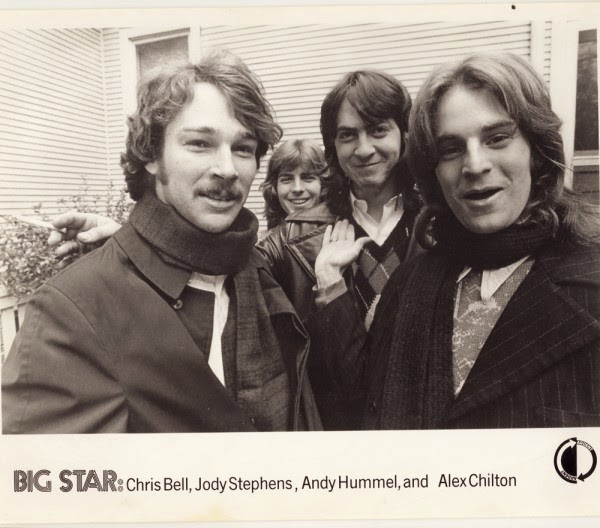
Big Star: there's no success like failure

Best bit in the Big Star documentary "Nothing Can Hurt Me" recalls their appearance at the one and only Rock Writers Convention in Memphis in 1973. "Suddenly they found their audience," somebody says. How true that is.

Groups who appeal to rock critics don't appeal to anyone else. This is made more certain by the fact that rock critics prefer bands who aren't popular. Nothing appeals to the rock critic mindset more than a band somehow too pure to appeal to the great unsophisticated. And they like bands who appear temperamentally unsuited to fame. Because a lot of rock critics are train wrecks themselves they feel validated by bands who are the same.

Big Star were celebrated among a bunch of people who thought that they could make a load of other people like them and then found out they couldn't. Of course they suffered from having the wrong record company and the wrong distribution but it might not have made much difference if they hadn't. Big Star were the progenitor of a seam of hundreds of bands who sound as if they ought to produce pop hits but don't actually have the common touch that you need to produce hits. They were never going to make it but there was enough pop DNA in their sound to make it seem they might.

Instead they had a very successful career as a failure. Their reputation grew over the years.  "They were like a letter posted in 1971 that didn't arrive until 1994," says Robyn Hitchcock. Actually, it's arrived at regular intervals since 1978.

The film starts with the original, purposely slipshod band in the studio in 1971 and ends with the great and the good of contemporary rock gathering around a microphone and a string section to respectfully pay tribute to the music they came up with. Watching that it struck me: is this the way Classical Music got started?

Thursday, August 28, 2014

Why acts don't make it - the brutal truth

I was listening to an interesting programme about Judee Sill which is coming up in a couple of weeks on Radio 4. Sill made a couple of very good albums for Asylum in the early 70s. She had a song called "Jesus Was A Crossmaker" that was almost celebrated at the time. Celebrated, at least, among the people who might have watched "Old Grey Whistle Test" or read the "Melody Maker". Obviously not mass but better known than most things.

Sill died in 1979. There had been a lot of sadness in her life: drugs, accidents, abuse. When that happens there's always the chance that thirty-five years later Radio 4 will commission a programme about you called The Lost Genius Of Judee Sill.

But here's the thing. When acts make it big they take is as proof of their talent. They did it on their own.

When they don't make it big they always blame it on something or someone specific. The record company went out of business, the radio banned us, the drummer left, there was a strike, there was an oil crisis or a war, there was somebody who had it in for us.

If the artists don't make such a claim then enthusiasts have to make it for them. The story here is that Sill outed David Geffen, the boss of her record company, on-stage. In this narrative he had his revenge by dropping her from the label. I'm not sure the record business works like that. It's more likely that his company had put out the two albums they were obliged to release under the terms of Sill's contract, records which hadn't sold. Therefore they decided their money would be better spent on somebody else.

Simon Napier-Bell was talking the other night about how performers have a combination of self-belief and chronic insecurity which you would consider mad if you encountered it in a member of the public. This same egoism drives them to believe that the only thing standing between them and widespread acclaim is some kind of wicked plot. They would rather believe that somebody has been deliberately trying to do them down than to accept the truth, which is that we, the public, weren't really bothered one way or the other. We're the villains, not the mythical "suits" or the tin ears at radio. Our natural state is indifference. We bought some other music or we didn't buy any music at all. We forgot. We passed by on the other side. We have lives in which your career doesn't figure at all.

When we don't buy your record it's nothing to do with you. As the ex-girlfriend would say, it's not you; it's us. But whereas she would be saying it to spare your feelings we would say it because it's the brutal truth.

But performers, whose job is the winning of hearts, find this impossible to face.

Makes me think of the episode of Frasier called "The Focus Group" in which the star is so obsessed by the one listener who says that he doesn't like him that he follows him home to try to get an explanation. With disastrous results.

Tuesday, July 22, 2014

When Ralph Coates was traded across the Harry Fenton Line

It's the time of year football clubs shuffle their playing staffs, moving young stars on to bigger clubs, despatching yesterday's stars to Hull.

These days they'll tend to arrive all looking the same, stepping out of blacked-out SUVs in skinny jeans and expensively distressed tee shirts, accompanied by disreputable-looking agents, everyone nervously fondling their mobiles.

If they sign they will swiftly move into the local millionaires' enclave. Once installed behind the security gates with their wife, family and dependent relatives, they need only to establish the route to the training ground, golf club and beauty parlour to be able to pick up life precisely as it was at their previous club a few hundred miles away.

 It's an interesting time to be re-reading The Glory Game, Hunter Davies's definitive inside story of the 1971-72 season at Tottenham Hotspur. It begins with the arrival of Ralph Coates from Burnley for £190,000, at that time a cash record for a British player. When Ralph was first told of the deal he said "no player's worth that", which gives you some idea of his modesty.

He and his wife don't have a house and so the club put them in a first floor flat on Green Lanes in Palmers Green. There's no phone or TV. I've lived near Green Lanes for the last forty years and there's never been a time when you could have imagined it as a suitable place to put a top footballer.  Even though it was widely accepted back then that top footballers were wealthy men, earning in some cases more than £200 a week, the Coateses worry about being able to afford the £15,000 needed to buy a house in the South.

When they get changed for their first pre-season training session, the rest of the squad, who were predominantly Southerners, stare at Coates's pointed shoes and narrow trousers, still the mark of the Northerner who hadn't gone South. They congratulate him on his shirt. He says thanks, not realising they're joking.

1971 was the year the flared trouser began to arrive on every High Street via chains like Take Six and Harry Fenton. After that we were all just as in fashion or out of fashion as each other. Maybe Ralph was the last man to move from the old world to the new.


Saturday, June 28, 2014

Pythons and privilege

Finished The Python Years: Diaries 1969-1979 by Michael Palin. Really interesting. You get the impression Cleese was living beyond his means from early on and that Idle always saw himself as a member of the jet set, which probably helps explain this year's reunion. These people have lifestyles that have to be maintained.

But even modest Michael doesn't really appreciate how privileged he is; or if he does he doesn't let on. In 1979 he's asked to open a fete at the local boys secondary school. He does it in the hope that his own boys will be able to get in to the school when they're old enough. Don't think that was ever in doubt. If you're famous enough to open the fete, you're famous enough to open lots of other doors. It's the kind of power celebrities prefer to play down.

Tuesday, June 17, 2014

Michael Palin's invaluable diaries of the 70s

I'm working on a book about 1971 and so I'm picking up any diaries that cover that time. Found this unopened hardback copy of Michael Palin's 1969-1979 diaries for three quid. Very glad I did.

Without meaning to it perfectly evokes the small irritations of daily life in the days when things didn't work. He and his wife and small child set off to France on holiday in an Austin Countryman. They drive to a tiny airport on the south coast where they board one of those front-loading planes, car and all, to make the short hop over the Channel. On their journey through France the car's exhaust breaks in two and he has to find a garage that can weld it back together.

When his wife goes into labour with their second child he has to take her to the hospital, then drop Child One off with a neighbour, then go home and ring the production office on the set of the Python film and hope they can rearrange the shooting schedule so that they can do without him for a day. Then back to the hospital where she's already given birth. Nobody expects anything to be easy or convenient. Python record a talk show on the West Coast in 1973 without stopping because the tape has to be flown to the next timezone to enable it to be broadcast simultaneously.

He's excellent on the morale-sapping reverses which are the showman's lot. They show the Holy Grail to the investors, who include members of Pink Floyd and Led Zeppelin, and it's only then that they realise it's not all that funny and in fact it's a bit depressing.

He's good on the politics of being in a band, which is what Monty Python were. Some members need the band more than others but none of them ever entirely escape it. He's the one who's always brought in when somebody's drinking gets out of hand, the BBC need stroking or some press chores need handling.

His diary reveals the difference between the person he thinks himself to be and the person he's become, as diaries often do. He frets about inequality while taking the £5,000 he's offered for one day on a commercial. He wanders around London wondering how long it will be before this or that much-loved old area surrenders to the wrecking ball. The funny thing is he's wrong about that. It's all still there. And of course nowhere in the diaries does he entertain the idea that they might all reform in their seventies in order to boost their pension pots.

That's the great thing about diaries. The hindsight is all ours.

Monday, June 02, 2014

Patti Boyd's misery memoir from Planet Henley

Read Wonderful Today: The Autobiography of Pattie Boyd yesterday.

She grows up in Kenya in one of those upper middle class families who find they don't quite have the means to sustain their status. Grandparents who smell of pink gin, parents rarely there, educated at a series of boarding schools.

She leaves school in 1961 at seventeen, gets a job as a trainee beautician in Bond Street and is immediately living in a flat in Knightsbridge. Somebody comes into the salon and tells her she should model, she gets some test shots done, she's featured in Honey which leads to advertising work and then a small part as a schoolgirl in "A Hard Day's Night".

George Harrison asks her out. Their first date is at the Garrick Club where their chaperone is Brian Epstein. After that she is lost to any kind of normal life.

Instead she has a thirty year career as the plus one of a rock superstar, first Harrison and then Clapton, thirty years spent in the numbing twilight world of country houses where the gravel drive is littered with the relics of the occupants' last craze, where the old school friend lives in the gatehouse and there's a recording studio in the basement in which barely a worthwhile note will be played.

The downside of being a Beatle girlfriend, she discovers, is that fans will try to do her physical harm. The drawback of being Clapton's wife, she learns, is that the only way he can keep a lid on his anger is by medicating with heroin or a pint mug of brandy and lemonade.

I find there are two ways to read rock memoirs. One is to take them in the chipper "well, that's what it was like with creative types back in the 70s" spirit in which so many of them seem to be written. The other is to set them down at regular intervals, shake your head and thank the almighty that none of it ever happened to you. Looked at in a certain light they're broad comedy. Looked at in another they're misery memoirs.

When I read stories like this I'm again surprised that nobody's got round to making a proper documentary about the lives of the dolly birds of the sixties. That's something I'd love to see.

Thursday, May 22, 2014

Was there ever a memoir as po-faced as Patti's?

Read the Patti Smith memoir Just Kids, which is candid, well-observed and well-written, as the reviews said, but did any of the reviews point out that it's completely lacking humour?

I don't expect a laugh riot but surely you shouldn't be able to look back at your formative years without either snapping into the foetal position under the duvet out of mortified embarrassment or dealing with the same feeling by having a bit of a rueful laugh at yourself. On the evidence of this book that never ever happened with Patti.

I remember seeing a TV interview with Ken Campbell back in the 70s where he said "anything that isn't in some way funny isn't true". I'd buy that.

Friday, May 09, 2014

Terry Reid and the incurable disease of being a musician

In the sixties everybody thought it was only a matter of time before Terry Reid made it.

He'd left school at fifteen to go on tour with the Rolling Stones. He was managed and produced by Mickie Most, who'd made Donovan and the Animals into hit acts. He could sing, play guitar and was considered the best looking front man around. Others took this quality more seriously than he did. The story goes Jimmy Page wanted him to be the lead singer of Led Zeppelin. Terry decided it wasn't for him and suggested Page should talk to another young singer called Robert Plant. Page asked "what does he look like?" Reid wondered why he asked.

Ever since then he's had to put up with people telling him how unlucky he was. He doesn't see it that way. Funny how we see the people who didn't make it as the victims of cruel misfortune. It's more useful to reflect upon the one in a million stroke of luck accounting for the tiny handful who did.

Terry Reid has his own idea what he wanted to do and a few years later he did it, putting out two albums, "River" and "Seed Of Memory", which, while leaving the charts unbothered, were widely admired. Ahmet Ertegun, who got him out of his contract with Most, paid for the first one, which was produced by Tom Dowd and came out in 1973. When Ahmet heard it he said "you've given me a jazz album". Both records are notable for their grooves rather than songs. Reid's theory was that if you could get the right musicians they would lean together and magic up the loose-limbed, Brazil-inflected music he heard in his head. He was right.

He moved to America in 1971 and has been there ever since. There were a few major label tries but nothing that took. He still plays. He was at the Jazz Cafe on Wednesday with a band of high calibre musicians who were clearly playing for the love of it as much as anything else. Where else would they get the opportunity to play this kind of thing? The voice doesn't have the silvery highs but the people who turn up don't care much about that. That's the funny thing about the expansion of rock cults. More people than ever like to tell everyone how underrated their favourites are, thereby making them no longer underrated.

I talked to him on Thursday at his lawyer's house. Amazingly he's had the same British legal representative since the late sixties. I know what Hunter Thompson said about the music business being "a cruel and shallow money trench" but it's surprising what pockets of sentiment and loyalty you still come across. Rob Dickins, who used to book him in the late sixties when he was a university social sec, signed Reid to Warners in 1991 for an album called "The Driver". Robert Plant is still in touch. Jack White's group The Raconteurs have recorded his "Rich Kid Blues". Admiring young musicians turn up backstage, aware that what he does they can't really do.

I dropped him off at the station in the rain. He was going off to Southend to stay with a friend. He's here for a month but it's not the kind of visit that stretches to a hotel. That's the music business in 2014. More people than ever playing for less money. What sustains live music is not so much the audience's hunger to hear as the musicians' hunger to play.

Talking of which, Alex Gold and I were on the tube yesterday when we bumped into Carl Hunter from the Farm. He joked that the group were getting together for "another of our Saga holidays". They had a few big hits in the early 90s, enough to ensure they still get a few down the bill bookings at festivals. They enjoy it and presumably just about show a profit. In any other business it wouldn't be enough. But this isn't any business.

Alex has just got back from touring Germany with a ukulele orchestra. The musicians were all ages and backgrounds. The oldest one, who used to be Lulu's bassist in the 60s, flew over from Alicante to join them. He passed on to Alex the best definition of being a musician I've ever heard. "It's not a profession," he said. "It's an incurable disease".

Terry Reid's UK dates are here.


Tuesday, February 25, 2014

In praise of Barbra Streisand's "Stoney End"

I'm recording a programme with Johnnie Walker this week and one of the records we're talking about is Barbra Streisand's "Stoney End". Yesterday morning when the sun was out I took a stroll with that one track playing again and again through my headphones. Boy, it's a jewel.

Sometimes proper singers can seem too good for pop music. I'm still haunted by memories of Ella Fitzgerald's baroque versions of Beatles songs. You can see why they do it. They think the songs are a bit beneath them. To my ears Laura Nyro's songs never seem to fly in her own versions.

But Streisand's "Stoney End" is a joy. In 1971 they made a lot of fuss about the fact that the album was produced by Richard Perry and included songs by all the hip young writers. That all helps but it's her genius as a singer that brings home the bacon. She goes into the chorus of "Stoney End" four times. Each time it's more  exhilarating than the time before.


Wednesday, September 11, 2013

If they'd had a Mercury Music Prize in 1971

The shortlist could have been:

Every Picture Tells A Story
Hunky Dory
Meddle
Led Zep IV
Ram
Imagine
The Yes Album
Message From The Country
Electric Warrior
Sticky Fingers
Aqualung
Fog On The Tyne
Teaser & The Firecat
Madman Across The Water
Who's Next.

Winner? I'm giving it to Who's Next with Hunky Dory as hon. mention.

Longer post here. Spotify playlist of 1971 classics here.