"World-class thinking about music, business, publishing and the general world of media" - Campaign
chaplin
Sunday, March 25, 2012
Remembering Eric Watson and the eternal struggle between editors and photographers
When I think back it's extraordinary the amount of effort that we put into picture sessions in those days. I remember spending two days at Eric's studio in Wandsworth helping organise a session for the Smash Hits yearbook. It was supposed to depict the changing face of a teenagers bedroom between the 50s and the 90s (which had yet to occur). Somehow we actually built a set in Eric's studio. And this was for an annual.
The relationship between magazine editors and photographers is always a difficult one. The former regard their business as commerce. The latter think it's art. Eric's work started off as one and ended up as the other, with exhibitions at the National Portrait Gallery. In the grown-up world of galleries and art dealers I'm sure they appreciate many of the qualities that made Eric Watson's pictures so beautiful and clever. What they'll never appreciate is what they did for you at the news stand.
Friday, March 23, 2012
A man in a dog suit is never not funny
Sarah has a dog called Wilfred. As far as she's concerned he's a regular dog - "Alsatian, bit of Lab, angry," she reports whenever he goes missing - with normal dog habits - wishes to sleep on the end of the bed, digs up the garden, eats everything. But her new boyfriend Adam comes to see Wilfred as we see him - as a six foot tall, dope-smoking slacker in a dog suit.
Once you've accepted that premise, which took me no time at all, you realise that dog behaviour, which is much like male behaviour minus the thin veneer of sophistication, is more often than not funny. Example: wishing to chase the ducks on the lake but being scared of getting wet, Wilfred confines himself to patrolling the shore shouting "C'mere, I want to tell you something."
There's a bonus. All standard male behaviour - sorting out his DVDs, sitting on the sofa pontificating, showing off in front of another male - is automatically funny once it's performed by a bloke wearing a dog suit.
I can't promise you'll find it as funny as I did - but you might.
Thursday, March 22, 2012
OK. Now what do we do?
Ad men always used to tell me that every ad had to finish with a call to action. In the case of a newspaper or magazine this was usually something along the lines of "buy it tomorrow" or "available now with free toy".
The Guardian ad doesn't finish with a call to action. Instead the message is that the brand can be accessed in a number of different ways. Which is true. But still a nagging question remains - does the lack of a call to action suggest that modern media organisations are no longer quite sure what it is that they can expect people to do?
Monday, March 19, 2012
Reality breaks out in the middle of a football match
I glanced across at the football and suddenly saw the genuinely shocked faces of the players as they reacted to Fabrice Muamba's collapse. When a player is in real peril on a football pitch the other players know it instantly and react accordingly. Their behaviour in these circumstances is so radically different from the usual operatic simulation of agony which is their stock in trade that it's surprising they don't find it more embarrassing. It's as if an actor in Romeo & Juliet has suddenly stopped the fight scene because somebody has really been stabbed.
You can't help thinking none of those players will ever be able to run on a pitch in quite the same way again.
Wednesday, March 14, 2012
Why people kiss and tell
She was perfectly pleasant about it and even introduced him to her partner. Skinner confessed to Lawson that he had no memory of her which is the kind of modest boast most men would like to be able to make. Then he pointed out that while he might have mentioned the many women he'd slept with in his books he at least had stopped short of identifying them. Unlike the women, many of whom will have been tempted to let slip at a dinner party that they once had a bunk-up with TV's Frank Skinner.
"Part of the purpose of casual sex," he says, "is anecdote production." This is truer than people like to admit. I know at least one person who had a one-off sexual encounter with a Very Famous Person. This person has been known to say "it was the best thing that ever happened to me."
Saturday, March 10, 2012
Adele leaves me cold & Bonnie Raitt doesn't
Adele's done a version too, which isn't surprising. I'm amazed that while the first one moves me the second one doesn't. They're in the same style and by common consent Adele "can sing", whatever that means. There are no egregious lapses of taste and no X Factor flights of melisma. The arrangement is no different. It's done in the same way. It presses the emotional buttons. It just doesn't touch me at all, which I realise puts me in a minority of one.
I'm sure a certain amount of it is prejudice. Bonnie Raitt's been a part of my life since I was 21. There is history between us. I will never be able to look at or listen to Adele in the same way.
But there's something beyond the prejudice, something beyond the inevitable discussion about "kinds of singers". There's something in the notes that come out of the speaker and the way they make me feel. What makes me warm to one and not the other?
Thursday, March 08, 2012
Why do Americans pronounce non-English words in such a pretentious way?
I watched Midnight In Paris last night. This is about Americans in Paris and therefore it's full of similarly mangled versions of well-known foreign words. Parisians becomes "Pareezhuns". The painter Monet is "Moanay". The sculptor Rodin is "Row-Dan". When the Sorbonne is first mentioned it's "Sorebone". The Boeuf Bourguignon is "Boeuf Berniown". The splendid old Peugeot which picks Owen Wilson up every night is a "Poojoe". This is not exclusively a problem with French words either. The well-known flat bread popular in Greece is "Peter Bread".
Obviously no nation is blameless in this regard but there's something about the way that many Americans - particularly sophisticated Americans, the kind you get in Woody Allen films - deliver these words that suggests that they feel that even the way the locals do it isn't sufficiently pretentious for them.
Wednesday, March 07, 2012
Why rock records are like cakes
There was a similar clutching at straws among those who confined themselves to discussions of the music. They ticked off the musical characteristics - choruses, types of guitars, production techniques - as if from a shopping list. I honestly can’t see the point.
Here’s the thing about rock records. Even to the trained ear they all sound the same the first four or five times through. At that stage those people who are predisposed to like them will convince themselves the record is great. Those predisposed to think the record's poor will convince themselves of the opposite. Those with 1,000 words to write will form an opinion that they don’t yet have. None of them know.
They don't know because the things that mark out the tiny handful of great records from the thousands of fair to middling ones only emerge over time and they do so when you’re not concentrating. Great records creep up on you like friendship. The things that make them great records are often not obvious on first acquaintance. Most cakes have the same ingredients. Only the good ones rise. And any baker will tell you that you'll get nowhere opening the oven door to check.
Monday, March 05, 2012
In defence of very rich men who own football clubs
I disagree. I don't think the likes of Flavio Briatore and Roman Abramovich or any of these people are fools. I think they may have some courtiers who are scoundrels and they all have fans who are quite happy to see insane sums of money spent on players' wages but I don't think they're stupid. The only lever they have on the business is the hiring and more often the firing of the manager and they have to do it sooner because if they're going to do it later it'll probably be too late.
The contrary view is that the clubs who have stuck with their managers, Manchester United and Arsenal, have prospered as a consequence. I think this is a fundamental misreading. Those clubs have stuck with their managers because, through some combination of good judgement, good luck and sheer effrontery, they have done well more than they have done badly. They've been retained because they've done well. They haven't done well because they've been retained.
Tuesday, February 28, 2012
The Moorgate train crash was 37 years ago today
I was thinking about that this yesterday morning when I stood on Palmers Green train platform. Some of those 43 dead may have stood there 37 years earlier. This line is now operated by First Capital Connect. It's called something different but it serves the same purpose - to get office workers from the suburbs of north London and Hertfordshire into the City of London.
I was thinking about it again last night while watching the first episode of The Tube, the new BBC series about how the underground works. My youngest was enthralled by this programme, by the steady thrum of the service, the seen-it-all look in the eyes of the staff and the drunken selfishness of a small minority of passengers. I've seen films about the Tube before but I'm always happy to watch a new one.
My reaction is always the same. Considering four million people get on the Tube every day and considering these metal bullets are being fired down these tunnels with such remorseless regularity and taking into account that the one thing we know is that the unforeseen does happen, it really is a miracle that these tragedies don't occur more often.
Sunday, February 26, 2012
Talk about a page-turner. I've just sat stock-still for two hours finishing this book
First published in 1981.
About a missing child.
Genuinely enthralling.
Why the "true fans" might not want to know the truth about ticket touting
The thing I really found surprising was that on the two occasions when "the act" was mentioned, it was taken for granted that they couldn't possibly know anything about this business and if they did they would be horrified.
The big acts - and it's the big acts that see their tickets being sold on for a 200% premium - are quite practised at turning a blind eye to things which benefit them. If only their fans were a bit less naive.
Let's assume I'm the manager of a hot group. As I look out into the arena I can assume that half a million pounds has been spent on tickets. The problem is that my act has only got £300,000 of that. I'd be failing in my duty as a manager if I didn't want my clients to get a share of that missing £200,000.
Ticket prices have increased beyond all reason in the last ten years. This is not solely because of touting and re-selling. It's because people have been ready to pay increasing amounts and the acts have increased their prices to take advantage of that. The problem they've got now is that they can't be seen to ask the prices they know that people will pay.
I don't actually know of a case of an act scalping their own tickets. However I would be absolutely amazed if it doesn't go on. Some exposé will eventually make that connection, although the concert business is so opaque it's unlikely they'll ever be able to prove it. The real problem is the public won't want to believe it.
Monday, February 20, 2012
What parents really mean when they ask “where are you?”
I’ve texted those words thousands of times during their growing-up years. You’re not really curious where they are because they swarm hither and thither in search of the place where the maximum number of mates are gathered. Where they are right now bears no relation to where they will be in half an hour. I discovered long ago that it was no use asking where they were going when they left the house because that was a decision that would eventually be reached as a result of scores of texts. Young people nowadays don’t plan because mobile communication has meant they don’t have to.
So I’m not really interested in where he is. What I really mean when I thumb out the three words “where are you?” can better be expressed in the three words “are you alright?” (a question which triggers a mental slide show in every parent’s mind, no matter how old the person you’re asking it of.) Obviously you can’t actually ask that question because it will come back over the net with vicious top spin. Of course, I’m alright. Why wouldn’t I be? Honestly...
It’s at times like these that you realise that the boom in mobile telephony has been driven less by freedom-loving kids than by comfort-seeking parents.
Saturday, February 18, 2012
Is this the end of the tearjerking movie?
Thursday, February 16, 2012
Tonight I met an act-or
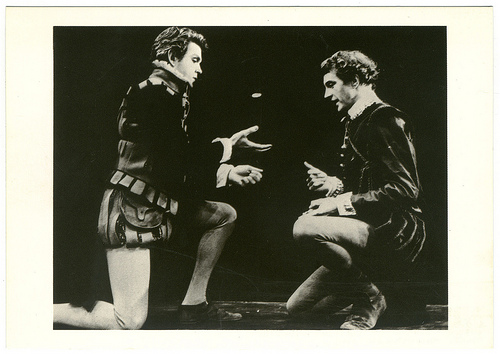
In 1967 I saw Edward Petherbridge (right) play opposite John Stride in the original production of Tom Stoppard's "Rosenkranz and Guildenstern Are Dead". Tonight Petherbridge told a story at True Stories Told Live and I reminded him of that production.
He ran through the cast for me and paused at Graham Crowden, who was The Player.
"Ah yes, Graham. Gathered, you know."
Sunday, February 12, 2012
Don't expect Kenny Dalglish to manage the modern footballer - it can't be done
This should be even clearer in the same month that Alex Ferguson, arguably the most powerful personality in European football, has let the extravagantly talented youngster Ravel Morrison leave Manchester United because he's come to the conclusion the boy is simply unmanageable.
This should be even more obvious this morning when we read that Roberto Mancini is considering letting Carlos Tevez back into the fold at Manchester City, just a couple of months after saying he would never darken their doors again.
The flavour of the month in management is our own Harry Redknapp who's being lauded for his "putting an arm round the boy" management technique. What this amounts to in practice is getting along with the players who are lucky enough to be in the team and hiding from the players who aren't.
Like all top managers, he only has power once a week when he fills in the team sheet.
The death of Whitney Houston and an original observation about stars - not made by me
Anyway, Dick James, who had been The Beatles publisher and was the man whose record company put out Elton's early records, is interviewed in that film and he says something that struck me as one of the most perceptive comments on superstardom that I've ever heard:
All artists can deal with adversity. I fact they thrive on it. I've never met one yet who could deal with success.
Saturday, February 11, 2012
There’s no pop like fairground pop
As the ride began the sideburned blokes who took the money on the waltzer or the dodgems would drop a blunt stylus on a scratched 45 of the latest hit.
Because not many cars had radios in those days the magical combination of music and movement was a rare thrill. It was particularly thrilling when it was getting dark, the smell of candy floss and beer hung in the air and the slightly slutty girls leaned back on the rails chewing along to the sound of The Ronettes singing “Be My Baby”.
Tuesday, February 07, 2012
(I Don't Want To Go To) Playback
It didn’t sound very majestic at all. Rather than call the record company person back to ask “does this sound all right to you?”, I scanned the thousands of buttons and faders on the massive desk until I found a toggle switch next to the tape player. I moved it from “mono” to “stereo”. That was better.
Just the other day I was asked if I’d review a new album by this same artist by going to the record company HQ for “a playback”, which is increasingly the form with big name acts. I said no, not just because I can’t bear the fuss but also because it’s no way to form a proper impression of a record. That you can only do when you’ve lived with it for a few weeks and calculated how many times you’ve found yourself reaching for it, which is the only true measure of worth.
There’s nothing wrong with doing the kind of track-by-tracks the music papers of the 60s used to do (“track three is an uptempo dance number with John singing lead”) but too often today’s critics try to pretend they’ve reached a conclusion which time has simply not allowed them to. Because they don’t feel confident enough to lay into a record they’ve only heard a couple of times they will tend to come back with something overly respectful and non-committal, which isn’t a lot of use to anyone. It probably suits the artist’s ego. Artists like making records but they’re mortally terrified of putting them out because that involves Judgement Day and playbacks ensure that day isn’t too judgemental. The “playback” ceremony also restores to the PR the High Priest role that the internet has robbed them of in most other respects. They like that.
I read reviews for their entertainment and enlightenment value. If I want a "verdict" on much-ballyhooed, maximum security albums such as those by the likes of Kate Bush and Leonard Cohen I'll find it in the columns of Twitter a month after release.
Wednesday, February 01, 2012
The films I can't be bothered to understand
I noticed the same thing happening with films the first and only time I saw The Matrix. I didn't understand it. This in itself is nothing new. What was new was my complete disinterest in gaining any understanding. I realised that the plot had probably been worked out in scrupulous detail so that it made sense in some way but I frankly couldn't be bothered to find out because I suspect I would have been underwhelmed by the conclusion. I decided to watch it scene by scene as if it was a collection of pop videos,
I felt the same about Source Code, which I watched this week. I feel that if it takes more than a minute to explain the premise of the film then I'm losing interest. This particularly applies in the science fiction idiom. If the hero has to ask lots of questions in order to establish whether he's alive or dead then there's a chance mere spectators like us won't be entirely sure either, which is bound to impair our enjoyment. I did enjoy it as a matter of fact but I probably only got about 25% of it.
Saturday, January 28, 2012
I prefer my sentiment in the past tense
What the book isn't is any way literary. It has no pretensions of any kind. It's clearly aimed at the broadest readership possible. Does anybody write this kind of thing anymore? Does anybody make heroes out of middle-aged people of modest means? I don't think so. Maybe this strand of writing just disappeared into EastEnders and I've no intention of following it there.
Funny how I can delight in the sentiment in a book like this and yet feel so resentful of the similarly manipulative, similarly middlebrow One Day. I suppose I've met people like the characters in the latter and I found them just as tiresome in real life as I found them in the book. Whereas I've never lived in a south London boarding house on the eve of war. Distance lends enchantment to everything, but particularly sentiment.
Friday, January 27, 2012
When Camilla went to court
Yesterday she appeared in front of the Leveson Inquiry to answer questions about where the internet fits into this whole privacy/decency/shemozzle. If, ten years ago, you'd have suggested to either of them that:
1. Popbitch would still be going in 2012
2. The News Of The World wouldn't.
3. Camilla would be called upon to explain to a judge how the media worked.
Well, it would be understating the case to say they would have laughed, that's all.
Monday, January 23, 2012
Plus one minus one
Clearly in the eye of a film director Laurie was what a rich rock star's girlfriend looked like. Two years after Annie Hall she committed suicide in the apartment she shared with Art Garfunkel. She's the girl on his left on the sleeve of "Breakaway". Makes you think.
Tuesday, January 17, 2012
The real reason there's no such thing as a retired rock star
Footballers have always known their time is limited. Over the last twenty years rock stars have begun to realise that theirs isn’t. It shouldn’t really be that way. If there ever was a profession for kids it’s rock star. It’s turned out to be the only glamour profession that you can still pursue in the buspass years. That’s one of the main reasons that people keep doing it. Most of them have tried retirement and discovered that they need that feeling when eight o’clock comes around. If footballers could carry on playing the way that rock stars do, they would as well.
Thursday, January 12, 2012
Before London went Gap
Derek and Simon's dad went to those places to take pictures because they knew that they could line up people there who didn't look like people anywhere else in the country at the time. In both cases a handful of people were trying out looks in those places which within a year would be in the windows of everyone's high street.
It doesn't seem to happen anymore. I can't remember when I last came upon a group of outrageously dressed people. If The Face was still publishing today it's difficult to imagine who they would be pointing their cameras at. It's all gone Gap and Facebook.
Tuesday, January 10, 2012
Two really good, very different podcast hosts
I'm interested in the contrasting styles of the two hosts. Football Weekly is anchored by James Richardson. He supplies geniality and warmth, qualities which might otherwise be in short supply. With the honourable exception of Barry Glendenning, the Guardian's pundits are a bit short on common man breeziness, as you'd expect from people who spend so much time working out the number of "assists" players have provided and give the impression that since England is, when all's said and done, a bit of a disappointment they would really rather be watching football in Italy.
The Game, on the other hand, is anchored by Gabriele Marcotti, who is anything but genial. In fact he might well be the most argumentative man in audio. Presumably the producers had to give him the presenter's job because otherwise he would overwhelm the others by dint of his great erudition and deep-seated desire to have the last word. So determined is he to prevail that in each podcast he lapses into a voice which is supposed to represent the man on the Clapham omnibus. He does this purely so that he can dismantle the man's arguments with a few savage strokes of his football intellect. It's like something out of Samuel Beckett.
They both work really well in their different ways because they both understand that the thing that matters most in podcasting, as in radio, is energy. If these presenters weren't there in their playmaking role the rest of the contributors would probably just sit there looking at each other.
Sunday, January 01, 2012
There's a big difference between manuscript and proof
I've blogged in the past about how Dickens reacted to first seeing his work "in print". Published writing is traditionally a series of stages, each of which sees the personality diminished as the seriousness grows. The editing, composing and proofreading stages that Dickens' works went through weren't valuable merely because they prevented him from making errors. They also gave him time to decide whether he really meant what he had written. I wonder how he would have got on in the world of blogs, where you simply have to hit "return" to send your most recent thought forth into the world.
Friday, December 30, 2011
The music of the Unknown Artist
There are only two generalisations about the sexes that hold good. When called upon to describe an item of clothing they once wore, women will always draw it on their body. When asked for their response to a piece of music, men will only tell you what they think once they know who it's by.
All minority evening radio works on this latter principle. Genre first, artist second, actual emotional response a distant third. It wonder if any radio station could find room for a programme which just played records based on what they sounded like and talked about them based on the things you could hear in them. Stupid question.
Friday, December 23, 2011
Sports Impersonality Of The Year
Baseball was an art, but to excel at it you had to become a machine. It didn’t matter how beautifully you performed sometimes, what you did on your best day, how many spectacular plays you made. You weren’t a painter or a writer - you didn’t work in private and discard your mistakes, and it wasn’t just your masterpieces that counted. What mattered, as for any machine, was repeatability. Moments of inspiration were nothing compared to elimination of error.Whenever players are asked to comment on a game in progress they'll tend to say "we need to cut out the errors". Commentators, on the other hand, say "they need to produce something special". Never read anything which illuminated the different ways of looking at it quite as well as this.
Thursday, December 22, 2011
The Importance Of Somebody Being Ernest

My Dad was called Ernest. That's him pushing my sister. Over the last thirty years we've watched the fashions in boy's names click by. We've seen the stalwart Edwardian names give way to the matier painter and decorator names of the 40s and 50s. We saw all sorts of unlikely names come back but my sister and I have always been pretty certain that it would be a long time before anyone would call a child Ernest again.
Today my wife was in the hairdressers next to another client with a four-week old baby. "What's his name?" she asked. The mother explained that they had combed through all the available names in search of something that wasn't going to turn up in those inevitable lists of the most popular names. They'd decided on Ernest. Best of luck, son.
Monday, December 19, 2011
Families at war and peace
The thing that makes it more remarkable is the fact that James Carville, the "raging cajun" who stars in the film as Clinton's chief strategist, is an item with Mary Matalin, who also appears in the film as a key spokesperson for the incumbent President George Bush. This seems to me like the definition of a civil society.
Friday, December 16, 2011
Why actors make such good bankers
Once they've gone Spacey gathers his remaining troops and reassures them that because they have survived they are a lot nearer to their boss's job than was the case a few hours earlier. They may miss the people who've gone, he says, but they know that ultimately they're the beneficiaries of the cull.
It's quite a shocking scene and the young actors (Zachary Quinto and Penn Badgley among them) manage to look shocked on our behalf. So this is how the world of finance works. This is the brutal downside to those big bonuses. How foreign that is to the lives the rest of us lead.
But then another thought stole over me. If there's one section of the population for whom this shouldn't be a surprise, one bunch of professionals who have spent huge parts of their young lives finding themselves on one side or another of an uncaring cull, who know what it's like to be figuratively escorted off the premises, who know that the difference between success and failure can be the flip of a coin, it's actors.
Thursday, December 15, 2011
Why don't we cough on the radio?
I've discussed this with broadcasting people before. How the adrenalin required to do radio or TV somehow shuts down all the receptors that make us want to cough or sneeze. On the stage it's known as "Doctor Theatre". The person on the stage will not feel the need to cough at all. The person down in the audience will find it impossible to stop.
Friday, December 09, 2011
Nobody wants a traditional Christmas more than yesterday's teenagers
When your kids are teenagers it's hard to get them very interested in Christmas. They refuse to go to carol services, lie in bed until midday on Christmas morning, nursing the hangovers they've acquired the night before, announce they're starving an hour before the meal is ready and start making appetite-destroying bacon sandwiches, then sit there texting their mates to work out the earliest they can get away from the obligations to hearth and home and reunite in a ravening wolf pack. They appear to have no interest in the simple joys of togetherness and give every appearance of preferring to be with their peers.
But then they leave home and go to "uni" and work, go and live in flats and houses alongside people who often are even less scrupulous about washing up than they are, run out of money in October, endure their first bout of flu away from the consoling arms of mother and generally come face to face with the truth that they're not all that special.
At that point they start becoming very concerned that Christmas is going to be observed according to the rules. They ring home to make sure you've got a tree, find out when it's being decorated, check that nothing unusual is being ordered in the way of food and do everything in their power to make sure that everything is being done "the way we've always done". It's interesting. You only find out about "family tradition" when you depart from it unknowingly and it's generally somebody in their twenties who reminds you of it.
Tuesday, December 06, 2011
If you're looking for a history book for somebody this Christmas
I've just finished this book. Most histories are written from the top down. The main chapters are devoted to the big stories. The personal details are in the footnotes. Sunday, December 04, 2011
How come the best women's sport is never on the TV?
How come the best all-women's sport - the one which is not a poor relation to the men's version because there isn't one, one which is clearly played by keen amateurs in parks and school playgrounds all over the country, one which is a brilliant spectator sport because it's intelligible to even a casual watcher - is never given any coverage in the media and also, even more bafflingly, is not included in the Olympics, which seems nonetheless to have found room for activities as marginal as synchronised swimming?
I'm talking about netball. It's a brilliant game. What did it do to get left out in the cold?
Saturday, December 03, 2011
What happens when Bruce Springsteen and Bob Seger stop
We were looking at the clip in the office yesterday. Kate Mossman was kicking herself that she hadn't seen through her plan to go to New York to see the show. Meanwhile Jude Rogers was getting very excited about the prospect of Springsteen's tour of Europe next year.
I don't think these two young woman were wrong to get excited about two old gits, people who had already made their names before they were even born. Though both performers are past their prime, when they're on stage they represent a vital link to the first two decades of rock and roll, an age that is fast disappearing over the brow of the hill in the rear view window.
That's why I would gently urge any interested young person to go and see Springsteen. (In fact I think a few of the old fans should step aside and make way.) When he stops doing what he does, nobody will be doing it at all.
You can see the clip here.
Monday, November 28, 2011
Funny how time doesn't slip away
When I was a kid, round about the time that Russell was making his film, you couldn't see the early life of an 80-year-old man. There were still pictures and the odd bit of over-cranked cinema film but you couldn't visit this place the way that you can with film. Now you can. Whether the pictures are produced by a professional or shot in your own back garden the past will always be with us in a way that it never was in the past.
Saturday, November 26, 2011
50 remarkable gigs I went to
2. Bob Marley and the Wailers, Lyceum, 1975. Best rhythm section I ever heard. Front line not shabby.
3. Bruce Springsteen and the E Street Band, Madison Square Garden, Thanksgiving, 1980. Afterwards they had a party in the bowling alley. The following week John Lennon was shot.
4. Earth Wind and Fire, Wembley Arena, 1980-ish. The drummer levitated and turned upside down while playing a solo.
5. Diana Ross, Wembley Arena, 1983? She had a tantrum over the sound and kicked a whole monitor off the stage with just her tiny foot.
6. Little Feat at the Rainbow on a Sunday afternoon in 1974(?) The Doobie Brothers literally couldn't follow them.
7. Haircut One Hundred at the Hammersmith Odeon at the height of Heyward-mania. Mark Ellen and I only men in the audience.
8. Yes at the LSE in 1972. We sat on the floor. This was the golden age of prog and yet it felt as low-tech and beat clubby as that scene with The Yardrbirds in "Blow Up".
9. The Jam at the Hope and Anchor in 1976. Ten people in the audience.
10. Randy Newman at the Barbican a few years back. Funniest and wisest man in pop.
11. Tom Waits at the BBC TV theatre in 1981. Audience had been bussed in to see Jim'll Fix It.
12. The Modern Lovers at Aylesbury Friar's in 1978. I Introduced them on stage.
13. Elton John at Wembley Stadium in 1975. Hot day. Girlfriend (now wife) and I sat baking on the turf. He played the whole of his new album in dispiriting sequence.
14. Paul McCartney at Earl's Court. It was the first gig that my whole family (youngest member, 7) demanded to attend.
15. Son House at the Commonwealth Centre in 1971(?)
16. Elvis Costello Sunday night residency at the Nashville Rooms in 1977.
17. Maria Muldaur at Ronnie Scott's in 1975. Shook the hand of Amos Garrett.
18. Richard Thompson at the 100 Club on the night before Cropredy a few years back. Teddy was playing guitar. The woman standing next to me was Linda.
19. The last night of the Naughty Rhythms Tour at Holloway Poly. I still have one of Pete Thomas's drum sticks.
20. Jean Michel Jarre lighting up the skyline of Houston in 1983.
21. The D'Oyle Carte Opera doing The Mikado at the Savoy Theatre ten years ago. Best performance of anything I've ever seen.
22. Led Zeppelin at Knebworth in 1978, watched from a lighting tower.
23. Stiff talent night at Eric's, Liverpool in 1977. Jayne Casey and Holly Johnson singing "I'm sticking to you because I'm made out of glue."
24. Marillion in Poznan, Poland, 1986. Band paid in zlotis which they drank afterwards in the hotel bar.
25. Ian Dury and the Blockheads, Sheffield City Hall, 1980. They screened "Deep Throat" on the coach afterwards.
26. The Headboys at the Moonlight Club in West Hampstead. Formerly Klook's Kleek.
27. Tinariwen at the Shepherd's Bush Empire last year. I have finally found my perfect vantage point.
28. Van Morrison and the Caledonia Soul Orchestra at the Rainbow in 1973. I *know* how disappointing he can be because I saw him in the days when he wasn't.
29. The J. Geils Band at the Midnight Court at the Lyceum in 1972. We walked most of the way home.
30. The Move at the Queen's Hall, Leeds in 1967. They didn't play but came on stage to apologise.
31. Geno Washington and the Ram Jam Band in Leeds, 1967. Somewhere in an arcade.
32. The B 52s at the Paradiso in 1979.
33. Greg Kihn and Sammy Hagar at some County Fair in upstate California in 1976.
34. The McGarrigles at Carnegie Hall. Rufus Wainwright came on and organised them.
35. Humble Pie at Walthamstow Poly 1971. Steve Marriott spat in the air and then walked under it.
36. Crowded House farewell at Sydney Opera House.
37. Took 17 year old son to see Bob Dylan at Wembley. "He'll be crap," I said. "He was crap," he said.
38. Louis Armstrong at Batley Variety Club in 1967.
39. The Decemberists at Shepherd's Bush Empire a few years ago.
40. The Rolling Stones at the 100 Club in the 80s. They were rubbish.
41. Britney Spears sound check at the Smash Hits Poll Winners Party in 1998.
42. Status Quo at Reading in 1977.
43. Michael Jackson at Madison Square Garden in 1986. I got in the hotel lift and there was Bubbles with his minder..
44. Live Aid.
45. Culture Club at the Dominion Theatre in 1983.
46. Boz Scaggs with his blues band at the Jazz Cafe ten years ago.
47. David Bowie on the "Station To Station" tour at Wembley. The longest, dullest drum solo in history.
48. The Grateful Dead at Wembley twenty years ago. Even duller drum solo.
49. Neil Young at Hammersmith Odeon when he played solo in front of bare brickwork.
50. Toumani Diabate played for me in his back garden in Bamako, Mali in 2007.
Thursday, November 24, 2011
Is Twitter the tabloid of tomorrow?
Wednesday, November 23, 2011
How PRs make their clients look bad
Dineen also revealed that she kept some information out of her film The Ark that could have looked bad for London Zoo. Lawson pointed out that this might be a dereliction of her duty as a journalist. She said she wasn’t a journalist. She was a film maker and she wanted to make a rounded picture of her subjects and she wasn’t interested in having her material obscured behind one big punchline.
It made me think that what she did was more like magazine profile writing. I thought this even more when she said that nowadays everyone has armies of PRs devoted to making sure she can't make the films she wants. It's the same in magazines. Subjects are scared of letting writers and photographers have any kind of personal access for fear that they will be ridiculed. PRs, frightened of losing their contracts, go along with it. You end up with a sterile half an hour in a hotel room and a boring feature.
The subjects of Dineen's films have ranged from insecure pop stars through crusty old buffers to blokes whose job it is to go round shooting unwanted calves. In her films they emerge as occasionally contradictory, sometimes absurd, but this only makes them easier to like. She’s not interested in making people appear bad or stupid because essentially she doesn’t believe that they are. I think I agree with her.
Sunday, November 20, 2011
If £8 for 90,000 Spotify plays isn't enough, what is?
"Got paid £8 for 90,000 plays. Fuck Spotify." That was a tweet the other day from the musician/producer Jon Hopkins. You can see how opening an envelope containing that royalty statement might catch you on the raw. Apparently an increasing number of smaller labels are removing their music from the streaming service because the revenues aren't worth it and they fear that it could have a detrimental effect on the sales of their CDs.
I'm not seeking to press Spotify's case but how big would the cheque have to be to make Jon Hopkins think it was worth persevering with them. Double? Triple? Ten times bigger? At what point does it seem about the right sum of money? Presumably at a point where Spotify decide they no longer want to deal with the Jon Hopkins of the world and will stick to Lady Gaga.
This kind of thing's happening all the time at the moment. In the days of scarce physical product prices were high and the winners could make money. Now we're in the world of digital product, frictionless communication and limitless supply even the rest of the field are achieving numbers and numbers make people think they should be earning money which is commensurate with those numbers. But it doesn't work like that. Writers are getting paid far less money (if they're getting any money at all) to have their work read by far more people on a blog than they would have got for having it read by a relatively small readership in a paid paper product.
Nobody knows anymore what the numbers signify. Presumably those 90,000 plays aren't the equivalent of 90,000 plays on a radio station big or small. (With traditional mechanical payments you get a lot more for having your song played on Radio Two than you would for having it played on a small local station.) Presumably 90,000 represents the number of times any one individual has accessed the stream on which the artist's song can be found. What's the average number of individuals it would take to generate that kind of activity? This 90,000 presumably includes a handful of people who listen to one song obsessively and a lot more people who just click once out of curiosity and never go back. It's not 90,000 fans. It's not even 90,000 listeners. It's 90,000 clicks.
If you sold 90,000 records you might expect to have done quite well. And you'd have reason to believe that you might be on your way to selling 250,000 records. You'd be some kind of a hit. If you'd had your record played just once on a radio station with 90,000 listeners you'd expect to get, well, eight pounds?
Monday, November 14, 2011
My strange afternoon with Linda Ronstadt
Avoiding mentioning that there was a time when an interview with Linda Ronstadt conducted in a recumbent position would have been a fantasy assignment, I assented. The following day I turned up at Claridges and was conducted to a suite where a make-up artist was just finishing touching up the make-up of Linda Ronstadt. She was sitting up in a king-sized bed with the covers carefully arranged over a decorous high-collared nightgown.
She apologised for the unusual circumstances and I interviewed her for about an hour. I've often thought back on that encounter in the years since. Obviously this makes me appear naive but it dawned on me very slowly that she probably hadn't hurt her back. What she was really doing was trying to avoid any press comment on the fact that she is a lot bigger than she was back in the day.
To which you might say, aren't we all? Yes we are but most of us are allowed to grow up and grow out without being ruthlessly measured against peers who are insanely motivated by their own vanity (such as Madonna) or slowly disappearing before our eyes (such as Cheryl Cole).
Male rock stars are constantly reminded of their younger, more beautiful selves. The unsinkable vanity of blokes means that they just shrug it off. Female rock stars don't.
Wednesday, November 09, 2011
Tiger Woods caddy and Oscars producer both got in trouble because they were desperate for laughs
Obviously both remarks could be construed as offensive, though since some papers are deleting the noun in Williams’ outburst while others have struck out the adjective it seems safe to say that people aren’t entirely sure how. Since we weren’t there at either occasion we are free to believe that both remarks were said with some bitterness, which they probably weren’t.
I think it’s more likely that both were said with a smile on the speakers face in the hopeful expectation that they would be justified by laughter from the audience. That’s not because people agree with either of the sentiments of the sentences but because audiences have become pre-programmed to laugh at the end of any sentence which finishes with a profanity. It’s how 50% of comedy works.
I’ve always taken the view that you shouldn’t use language in a public gathering that you wouldn’t use at a school speech day. Not only does it run the risk of going wrong, as it has done in these cases, but it’s terribly needy. Just how desperate are you to get a laugh?
Monday, November 07, 2011
The record collection that matters is the one in your head
Of course with Amazon and iTunes we can now access far more records than can be accommodated in even the biggest record shop, but what we don't have is any equivalent of the record shop's display function. All that often bewildering range has been replaced by the tiny window represented by the home page of iTunes and it's harder and harder to remind yourself what you might like to listen to. That rack of records that you used to run your finger down has been replaced by a computer "containing" everything. You know it's all back there but you don't know what lever to pull to bring it forth.
In the future we'll increasingly be presented with limitless range behind the tiny window. To deal with it we will increasingly fall back on the music we can immediately call to mind and that often means the music that we first heard at an age when we were unusually receptive. In my case that's the 70s, a decade which was far broader than cheap jokes would suggest. If I set my internal compass for that decade I can instantly come up with a whole load of records that I love from that time. If somebody asked me to do the same for the 90s I'd go blank.
If you're interested in what came out of my head yesterday, here are 66 of them.
Friday, November 04, 2011
There's nothing you forget more quickly than yesterday's technology
Wednesday, November 02, 2011
It's amazing when you remember something from a book correctly
Tuesday, November 01, 2011
Like Pete Townshend, I miss the record companies
I've been reading the text of Pete Townshend's John Peel lecture. He makes the perfectly valid point that what record companies and music publishers used to do was a form of banking. You know banks. They're the people we tolerate when they're lending us money and despise when they're wanting some return. *Just* like record companies.
I've been waiting for this for the last few years. Now that record companies are not the force they were we get nostalgic about them. We realise the things they did and wish they still did them.
When you had to buy an album rather than cherry-pick a track record companies could afford to subsidise acts to go on tour.
When that album cost £10-£15 they could take some of that margin and spend it on marketing, which meant music magazines got advertising.
When record stores were the shop window, the companies could hope that your attention might be attracted by something you hadn't gone in there to get.
All that's gone now. People download individual tracks, which means even successful acts get a fraction of a fraction of the revenue. Record companies can't afford to spend money on promoting records. All that matters nowadays is getting into those few inches of space occupied by the home page of the iTunes store.
What used to work in the artists' favour, although they could never be caught admitting it, was competition between record companies, struggling to elbow each other off the airwaves, out of the front window of HMV and off the cover of NME. In order to achieve this they would spend lots of money. They'd pay big advances, invest in name producers, buy advertising spaces, press up lots of copies, distribute them and then spend more money on ballyhoo in an effort to move them out of the shops.
And when one record company failed to break an artist, as they usually did, there would be another one waiting to have a go. I don't buy the idea that artists are cast aside as soon as they don't sell. I'm consistently amazed to see how commercially unsuccessful artists keep on making records. This is the business from which NOBODY RETIRES. Hope springs eternal in the record business.
I agree with a lot of his analysis but I can't see iTunes, or anybody, adopting Townshend's recipes. I can't imagine lots of talent spotters sitting there patiently ploughing through MP3s. I don't know whether everybody who writes a song has the right for it to be heard any more than anybody who writes a blog has the right for it to be read. In the days when John Peel listened to every demo there was barely any email. He would only receive them from the relatively small number of people who could get up off their backside, make a record, pay to get it pressed up, buy a Jiffy bag, take it down the Post Office and send it to the BBC. Believe me, it's not like that today.
Sunday, October 30, 2011
Was Charles Dickens the first rock star to go on a never ending tour because he needed to be loved?
Her depiction of the novelist in later life, spending much of his time "on the road" in order to maintain his increasingly lavish and complicated lifestyle, recalls nothing so much as a legendary rock star on a never-ending tour, playing the arenas in order to enjoy the uncomplicated affection you can only get from a bunch of strangers.
The applause and praise received at readings became increasingly important as balm to his wounds, allowing him to believe in his own goodness. Having specialized in being a good man for so long and been known as such to the public, he was intent on keeping his good reputation: hence the public statements putting others in the wrong.
Thursday, October 27, 2011
I've decided not to enter Parliament
This was the first time I’d taken part in a formal debate since the age of fourteen. Actually, I took part in one a few years ago at the Oxford Union but that was to a hall full of students. They wanted rabble rousing so rabble rousing they got.
The atmosphere at this debate was very different. The room was full of the great and good of publishing plus a load of people whose idea of a Monday night’s entertainment is popping out to take part in a debate. Any one of them could easily have taken apart my logic.
The usual speakers trick - make eye contact with anyone who looks sympathetic - doesn’t work. You don’t know where to pitch your tone of voice. The atmosphere leaves you unsure whether to declaim or converse.
You can prepare your opening remarks but at the end you have to summarise what’s been said by your opponent and the speakers from the floor, take some of it on board, kick most of it into touch and then somehow restate your argument. It’s very hard. I emerged from the experience with new respect for parliamentarians and a fresh understanding of why so many of them are former barristers.
Friday, October 21, 2011
Why the tappety-tappety office of today is a bad place to learn things
Monday, October 17, 2011
Steve Hewlett, the Media Show and the question nobody in the media can answer
I just caught up with a recent edition where he interviewed The Guardian's Director of Digital Engagement about the practicalities and ethics of their new Facebook alliance and the new editor of The Independent, Chris Blackhurst, about press regulation, Johann Hari and the future of the paper.
When he asked "Do you think the Independent will still be here on paper in five years?", the editor said that this was difficult to predict, which is a pretty remarkable answer if you think about it.
A John Humphreys would not have been able to let that answer go by without mocking the inability of the newspaper to be able to see its own immediate future. He would have repeated the question in a number of different ways while the editor shifted from foot to foot and eventually muttered something about having to speak to his superiors.
Hewlett didn't bother. He knows that the media is the land of vanished certainty. To pursue the question would only have tempted Blackhurst to make something up. I'm very glad he didn't.
Saturday, October 15, 2011
How to get some more young people into The Archers
There's something else that makes this notional village near Birmingham exceptional. 21% of the UK population work in the public sector in some shape or form and yet Ambridge doesn't boast a single teacher, nurse, road sweeper or retired civil servant. Not one. The only person who is reliant on the public purse is Clive Horobin, who's just been released from prison. This sylvan hive of industry must be the motor that is keeping the British economy going now that the North Sea oil has run out. I'm surprised it hasn't been on the news.
A friend of mine lives in a small hamlet in the (real) East Midlands. The residents recently noticed that somebody had moved into the large house on the edge of the settlement. It seemed to be occupied by a number of willowy young women who tottered down the shop on very high heels to buy the cigarettes which seemed to be their only form of nourishment. A number of burly gentlemen looked out from the front of the property.
It turned out, of course, to be an east European-run knocking shop. The locals reported it to the police and it was shut down quite promptly. Now wouldn't this make an Archers plotline? It would be both stranger and truer than what's going on in Ambridge at the moment.
Friday, October 14, 2011
Politics is a dialogue of the deaf
Having established my wife is a teacher, the younger of the two, in his thirties but probably not a parent, said "I see Michael Gove is going to make it OK for them to hit pupils".
I think he expected to enlist my automatic disapproval. I widened my eyes in the "you don't say" expression I use when I don't want to pursue a line of conversation.
The older of the two, definitely a parent, said "some of them want a good hiding" and carried on with his work without looking up.
This is why I don't watch "Question Time".
Thursday, October 13, 2011
Happy birthday to Paul Simon, the man who's made more great pop records than anyone
"Baby Driver", a track from Simon and Garfunkel's "Bridge Over Troubled Water", popped up on my iPod last night. It struck me, as it does from time to time, that Paul Simon's musical reputation suffers because he doesn't represent anyone but himself. I tweeted to the effect that no individual writer has more great pop records to his name than Paul Simon. @MaggieA, among others, contested this view, suggesting that Joni Mitchell had more.
Today is Paul Simon's 70th birthday so it seemed as good a time as any to offer this Spotify playlist as evidence. Life's too short to get bogged down in defining what is and what isn't pop. It stands for popular. Pop records, to my mind, exist independently of the artist. They are familiar to people who aren't very aware of who made them and don't much care. If I was putting music on the computer of a radio station these are the Paul Simon-authored records I'd put on there in the confident expectation that when they came up on the airwaves people would say "I know this one".
I've cheated in including his first hit "Hey Schoolgirl", which was in the fifties, but I haven't put in anything from his recent "So Beautiful Or So What" or any of his much-admired but relatively uncommercial records of the last few years. Even without those his achievement is exceptional. Big hits as a member of a duo, for whom he wrote all the songs and did most of the singing. Big hits on his own in the 70s. Even more big hits on his own in the 80s. Songs like "50 Ways To Leave Your Lover" and "Still Crazy After All These Years" which are still a boon to headline writers all these years later. Only Paul McCartney can boast a comparable span.
Oh, and I didn't include "Baby Driver".
Tuesday, October 11, 2011
Women drinking pints and other things that give the lie to costume drama
I don't remember exactly when women started drinking pints but it wasn't in the sixties and the last people you would have seen with a brimming beaker in hand were these would-be Jackie Kennedys.
I've adapted to many things but women and pints is something I've never quite got used to. It just never looks right to me. It's obviously one of those things that betrays one's age.
Back in the early 70s the only woman I knew who drank pints was a roadsweeper I worked with during a student vacation. She used to have two pints at lunchtime and a lot more in the evening. She was probably in her fifties and wore bright red lipstick framing her solitary front tooth. I want to call her Lil.
I can't expect the makers of today's period dramas to recognise their own bum notes. The world of Pan Am is about as distant from today as the Edwardian world was from the makers of The Forsyte Saga in the mid-60s. Back then there were probably Edwardian etiquette books they could consult to establish how polite society had been ordered. There's nothing you can refer to which rules with similar authority on what went on in more recent times. When women started drinking pints it was as much a watershed moment as the first appearance of a mini skirt. Nobody, however, seems to have marked it.
Friday, October 07, 2011
There's a difference between changing the world and selling it toys
"They're leaving flowers outside the Apple Store. What has happened to us?"Couldn't help but sympathise. Steven Spielberg described Steve Jobs as "the greatest inventor since Edison", which can't be right. What about the airplane? The rocket to the moon? The technology which enables keyhole surgery? Antibiotics?
More to the point in Steve Jobs' case, he probably wouldn't have claimed to have invented the personal computer or MP3 player, the products with which he's most associated. He was a man who had a genius for perfecting such products and then marketing them. However nobody mourns a brilliant marketeer.
Did he "change the world", as all and sundry were claiming yesterday? You could say that he was a brilliant maker of toys. That's not to diminish him or the sense of loss of those around him. I've got all his toys and I love them. But I do worry what our possession of these toys may be doing to our sense of proportion.
Another Tweet I saw yesterday came from Richard Coles.
"William Tyndale, translator of the Bible into English that ploughboys might be as learned as bishops - burned for his trouble on this day."Now William Tyndale. There's a man who did change the world. Got no thanks for it either.