chaplin

Wednesday, August 18, 2010

I wouldn't buy a £50 ticket in a £30 economy

Happened to catch a tea interval conversation on Test Match Special between Jonathan Agnew and the bloke in charge of the Oval during yesterday's England-Pakistan test match. The subject was the poor attendances we've seen during internationals in other parts of the country finally starting to affect the London matches. The Bloke, who was very reasonable and perfectly happy to accept criticism, admitted the evidence seemed to be pointing to the fact that the prices might be too high. The cheapest ticket to attend a London Test for just one of its five days was £50.

He let slip that he'd always believed that if people would pay £30 they would pay £50. This is a classic example of how prices rise in a boom. The people setting the prices - whether they're the people running the Oval or the managers of your favourite indie rock band - keep pushing the price until they feel the market begin to push back. They do it in bigger increments all the time. It's not hard to see their reasoning. They've got to make up for massive shortfalls elsewhere, whether it's the drop-off in record sales or attendances at county matches, and they argue that £50 for six hours of top class sporting entertainment seems reasonable, certainly compared to whatever you have to pay at Chelsea or Arsenal or the Grand Prix.

This is not how the customer sees it. The customer, generally male, sees it as £50 each for him and possibly his wife; then maybe another £50 for two offspring; add in the general expenses of a day out (transport, parking, food, drink, unforeseens) and it's not hard to spend £200 on what could turn out to be a weather disrupted day of no great distinction without any winner at the end of it. And here it's not like football. Our man could spend £200 and return home with a family which is less happy than the one he went out with.

It's the same with rock bands. You might be able to demand £50 for your absolute favourite performing at the top of their game in a perfect venue. Problem is that a lot of the time you're delivering the act you've always kind of wanted to get round to seeing performing a ho-hum set in an unsympathetic venue with rotten sight lines. People don't go home from an unsatisfactory day or night out saying, oh, well, you have to take the rough with the smooth. They go home feeling angry and swindled.

Part of the answer, of course, is for the £50 ticket to go back to being £30. At £30 you might be prepared to take the risk. For £30 you might be prepared to give the event the benefit of the doubt. It ultimately makes a kind of sense for the promoters too. Already in the USA this summer they've been slashing the prices of tickets for big stadium shows because they have to get people in there to buy the tee shirts and to pay for the parking. Otherwise they're stuck with hugely expensive real estate with nobody in it. There's a piece about this in the latest issue of The Word.

While the web has had a deflationary effect on most things over the last few years, with live entertainment it's pushed prices in the other direction. This seems to be at an end. You can't go on charging £50 when everybody out there knows it's a £30 economy. Not unless you're going to be able to guarantee the experience.


Monday, August 16, 2010

The fathomless stupidity of the Football Association

I've long suspected that the Football Association, with its rotating cast of chief execs, long-established reputation for appointing bottom pinchers to senior positions and inability to produce a football pitch with grass on it, is the worst-managed organisation in the world. Last week's announcement that the next England manager would definitely be English confirmed this supposition beyond reasonable doubt.

There may well be good reasons for appointing an Englishman. There is not one good reason for announcing this is what you intend to do at some point in the future. Where does it get you? It means that you can't have a conversation with any candidate from another country. It means that the three English managers who could claim to be qualified for the job know that they've got the whip hand in any negotiations. And what are you going to do if Fabio Capello wins the European Championship? Why in the name of all that's holy would any organisation show their hand in this fashion?

Saturday, August 14, 2010

The Complete Smiley is the ultimate mile-melter

Yesterday we drove back to London from the south western tip of Brittany. It takes about thirteen hours, which can be tedious. This time the journey was considerably lightened because we listened to ten hours of The Complete George Smiley, Radio Four's dramatisation of all the John Le Carré novels that feature his hero George Smiley, "the last illusionless man". It's over twenty hours of running time in total.

It makes great radio drama because most of it involves characters who choose their words with surgical care. Hearing great actors like Simon Russell Beale, Brian Cox and Eleanor Bron delivering lines like "a nation's secret services are the only real expression of its sub-conscious" or "between us we'd make one good man" is a rare treat. The plots are easier to follow than in the TV adaptations or the original books because on radio they have to be. Every now and then there's a "doof-oof-ratatat" interlude indicating that somebody has been shot trying to escape. A voice quickly and plausibly tells us who it was.

We haven't finished it yet. The thought that we might do so makes the prospect of driving to Glasgow in a couple of weeks time a bit less of a chore.

Sunday, August 08, 2010

I envy the people who stay late at the beach

On holiday in Brittany we end each day with a post-prandial walk on the beach. No matter how late we leave it there will be some family group still down there, making sand castles, playing volleyball, swimming or doing something else that most people stopped doing at the end of the afternoon.

Ever since I can remember I've envied the people who were still on the beach long after the rest of us had made whatever concession we needed to make to getting ready for dinner. I can remember looking out of the window of hotel dining rooms and seeing a handful of kids still out there playing, the whole beach to themselves. How did they do that? How could their parents be so relaxed?

I've concluded it's an attitude of mind. The people who are still on the beach at nine o'clock aren't worried, like most of us, about making their leisure fit the dictates of a clock. They're not terrified that Junior will never go to sleep if he doesn't get fed by a certain time. They're not haunted by the fear that they will arrive at the restaurant too early or too late. They're not suffering the agonies of the rest of us by trying to make everything perfect. They're built for holidays in a way that most of us, sadly, aren't.

Friday, July 30, 2010

The real Barbara Hepworth

This young flapper, who looks as though she's learned the secret of life and is keeping it to herself, is the sculptor Barbara Hepworth, as she was about to embark on her brilliant career.

As a girl she attended Wakefield Girls High School. Forty years later, my sister, who is also called Barbara Hepworth, sat the entrance exam for the same school. One of the teachers chirruped brightly to my parents, "we can only hope she'll do as well as her illustrious namesake." My parents, who didn't stay abreast of the visual arts, smiled thinly and pretended they knew what the teacher was going on about.

Anyway, the Hepworth Wakefield is a major gallery opening next year. I've tried to interest them in getting my sister to cut the ribbon. They've not bitten so far. Mind you, she hasn't agreed either.

What musicians are thinking when they look at the audience

I was talking to a young musician friend recently. He plays in his own band but also goes out regularly doing covers in pubs. "You've no idea," he said, "how difficult it is to get people to listen."

I've been thinking about this ever since. Maybe part of the reason I've been able to persuade musicians like Chris Difford, Mary Gauthier and Barb Jungr to come along to True Stories Told Live and just perform for ten minutes is because they know how precious somebody's undivided attention is. In some ways they're happier playing to a listening audience for ten minutes than competing for the attention of a bigger, paying crowd for much longer.

I'm always amazed by the resilience musicians show in walking out in front of people who would clearly be happier drinking, eating, talking or being entertained by someone else. I try to put myself in their shoes and imagine how the world looks from the other side of the monitors. I often wonder why they don't just walk off.

I was thinking about this again this morning while looking at Amy Rigby's excellent blog. She's an American musician who's married to Wreckless Eric. They live in France and play wherever they can. This never was an easy life and it's harder than ever right now. There's no record company, no management, no structure, no career path, just a life. Unlike many musicians Amy Rigby is perceptive enough to notice the audience and candid enough to write about them. This is a show the other night:

Today I'm recovering from our gig at the Site Corot last night. Held in an unused auberge in a lovely spot near a river, next to some old glove factories, it took five meetings and three months to organize. Many people showed up, having been told we were either a) a "rhythm and blues" group or b) country music. They stayed for about three songs and the rest of the set we played to our usual ten friends and the few assorted French people too polite to desert us. But the river made a nice sound and we still remembered how to play.

The dread and anticipation, the inevitable misrepresentation, the evening that peters out before it is meant to, the embarrassed silences, the battering taken by the confidence: sounds like nothing so much as a blind date.

Wednesday, July 28, 2010

People take cabs when they think they're important

Half a year in, haven't lost the shiver of pleasure that comes with telling cab driver, "Conde Nast building, please."
It would be unkind to mention the name of the person who tweeted this yesterday. There's nothing wrong with a young person being really excited that they've got a job on a New York fashion magazine. What's interesting is the reference to the cab, which the tweeter probably didn't even notice.

There are many legitimate reasons for taking a cab: to complete a journey difficult to make by public transport, to transport heavy packages or for safety late at night, for instance. (Obviously it can't be for convenience because in London cabs spend most of their times in traffic jams.) However the impulse that causes people to raise their arms to the noonday traffic and take a cab is the heart-pounding, almost erotic feeling that they are far too important to be transported any other way. The fact that their employers are happy to refund cab expenses in certain jobs confirms them in this feeling that their work is of an order that demands they be moved about separately from the rest of us, that they be not impeded in any way and that, wherever possible, they be given the solitude to think about their next move. They're about status, not transport.

During economic boom nobody bats an eyelid. It's different right now. If I took cabs for work I would be keeping pretty quiet about it at the moment. Spotlights are being shone hard on the running expenses of public bodies and the amount of money being splashed on cabs does rather stand out. If you've got a moment, just Google "taxi expenses" for a selection of eye openers. This is just one.

Saturday, July 24, 2010

Where's the 6 Music of talk radio?

For a couple of months earlier this year the nation discussed the future of a minority music station as if its survival were the thin membrane separating civilisation from the abyss. The debate around 6 Music essentially hinged on whether there was only one kind of pop music or whether there were many. It was concluded there were many and 6 music was a sufficiently distinct variety to preserve.

Shouldn't there be a similar debate about whether the BBC could be providing more than a couple of varieties of speech radio? At the moment we have the news, arts and lifestyle mix of Radio Four; we also have the news, sport and phone-ins mix of Five Live. Both are admirable but it's clear that they do not cover the full range of what licence fee payers might wish to listen to.
Three things made me think about this.

Firstly, the appointment of a new controller of Radio 4 spotlights the peculiar challenge of introducing innovation in a place where listener satisfaction is so high. Anything new has to come by removing what is already there, which will be fiercely loved by somebody. If there is any change at Radio Four it will be at the margins.

Secondly, the uneasy introduction of "Men's Hour" on Five Live demonstrates how stylistically inelastic BBC stations are. The controllers have a highly-tuned idea of what fits. After a while the listeners become just as sensitive to what jars, which makes any innovation difficult.

Thirdly, I was listening to This American Life, Ira Glass's long-running show for NPR in the States, and wondering why British radio, for all its qualities, can't produce anything similarly soulful, hip and clever. The answer, at least to a certain extent, is it wouldn't fit anywhere.

There's no use looking to the commercial radio industry to provide anything like this because there isn't the advertising to support it. However you would have thought that the BBC, even in its current hair shirt mode, could divert a tiny amount of its budget (maybe the bit marked "taxis"?) to send up a probe of some kind to see if there is some new way of providing speech-based entertainment.

6 Music was saved on the basis that it did something that the commercials couldn't and, for many people, justified the licence fee on its own. Couldn't the same thing apply with a new form of speech radio? And surely it doesn't have to be a bureaucracy? Might it be possible to do something cheap and cheerful, without the normal overheads? Could it not curate material coming in from other sources rather than operating in the belief that all good ideas come from the centre? Why not start its own pirate ship? The web is teeming with talent and ideas which would benefit from some kind of broadcast outlet and at the moment digital radio has no reason to exist. This seems an opportunity to kill a number of birds with one stone.

Everywhere in media - whether it's in the big publishing companies or people running websites from their sheds - operators are having to contemplate doing things in an entirely new way. They're driven by necessity. The BBC, the only organisation in the media that has at least a rough idea of its revenue for the next few years, could innovate out of choice. I think they'd be surprised how much support they would get.

Why do the British press keep on getting burned by Hollywood?

Once again a British tabloid, in this case the News of The World, has to pay some American movie stars, in this case Brad Pitt and Angelina Jolie, a lot of money for falsely claiming that their marriage is at an end. You wonder why British hacks in Covent Garden or Wapping persist in pretending that they know what's going on with the domestic circumstances of faraway film actors who spend most of their time behind an expensive wall of PR deceit. These people's lives are so unusual and so completely consumed by their careers that it's possible that even they don't know how they stand, let alone some hack Googling away in London whose knowledge of Hollywood is limited to reading the odd feature in Empire.

Nonetheless every week our news stands groan with magazines claiming to know what Jen said to Brad this week. They can't have a clue. Think about it. If they did know what happened behind closed doors in Hollywood on Thursday night then they would have a highly-placed mole who would be looking for an Andrew Morton-style book deal. If they're just resorting to the same old scuttlebutt as everyone else they may as well be reading Perez Hilton. What eats away at the print media is the conviction that if they keep on speculating about a celebrity marriage then experience suggests that one of these days they'll be right. But guessing may be becoming a prohibitively expensive business.

Wednesday, July 21, 2010

The Googling classes

Poet Jackie Kay is reading her autobiography "Red Dust Road" on Radio 4 at the moment. I only caught the latter half of yesterday's broadcast but she described how she traced her Nigerian father. She'd never met him but she knew his name and that he was an academic. She didn't know how to go about finding him. Then a friend made the suggestion I imagine most of the people reading this blog would have made. Why not Google him? Within seconds she found him. Academics are a breeze on Google.

The world is now so firmly divided into people who Google everything and those who rarely think of it that it's almost become an alternative definition of intelligence. I was sitting on the tube the other night facing somebody wearing a security pass for an educational institution. It had their name and picture on it. They'd made no effort to conceal it. They got off at my station. With nothing else to do while waiting for the bus I looked on the web on my iPhone, entered just their title and first name plus the name of the institution into Google and within a couple of seconds I had their CV. I do things like that because I'm a nosy hack but it would be just as easy for somebody who wished to steal their identity. The person who would probably be most disturbed by this prospect would probably be the person who didn't make the basic effort to conceal the pass in the first place. If they were in the Googling classes they would make sure they hid it.

Monday, July 19, 2010

Looking out for each other

Alice Glass of Crystal Castles made a plea from the stage for rapists to be castrated. The BBC Suffolk website said that "regular festival goers were shocked by the attack". The Daily Mail added that "police began patrols following the second attack in an attempt to curb fears among festival-goers" and, having found somebody who talked like a sub-editor, quoted her as saying "Now everyone is left reeling after this second rape". The Guardian wagged its rarely-used finger and said following these two alleged incidents that "safety must become Latitude's top priority".

It's difficult to believe that these reports were written by people who actually went to Latitude, most of whom passed a pleasant sunny weekend without being aware of any attacks or any police presence of any kind. It goes without saying that any attack is serious and, if proven, the law should deal with it. I went there (with wife, two daughters and a friend, for what it's worth) and would happily do so again.

In any place where 35,000 people gather there's likely to be some crime. The notion that the organisers of a gathering of this kind can guarantee the safety of every individual all the time is ridiculous. The organisers of an event can be expected to provide security fences and adequate lighting but they cannot legislate for what might happen if somebody stumbles off on their own in the middle of the night. One of the stage announcements I remember from the Woodstock film in 1969 was along the lines of "the man next to you is your brother so look out for each other". This seemed to me to be true back then as it is today.

My son and his girlfriend - final year students at Leeds University - were recently returning to his flat late at night when a cab pulled up and dropped off a young woman who was so drunk they had to help her open her front door. They didn't know her but they took her inside, put her to bed and decided they couldn't leave her in case she vomited. They found her mobile, got the number of her friends and rang them. These friends were still in the club that she'd somehow left. They didn't seem overly concerned about her but promised they'd come back and take care of her. It took the best part of two hours for the friends to return.

I don't think any society can ever stop random attacks taking place but I'm regularly shocked when I see how often drunk young people fail to, in the words of Chip Monk at Woodstock, "look out for each other". Alice Glass, The Guardian and anybody else who can get the ear of young people would be more usefully employed ramming home the message that the safety and well-being of your mate is your responsibility, no matter how drunk and temporarily obnoxious they may be, than waving their arms around and expecting this problem to be solved by either security men or public executioners.

Wednesday, July 14, 2010

Every picture tells a story

Went to a press preview of the Camille Silvy exhibition at the National Portrait Gallery. Silvy was a French pioneer of photography in the 19th century, working on both sides of the channel in the period before anybody had a clear idea of how you might make a living out of the new art.

There are entire folders of all the people he took pictures of in his London studio, from memorial pictures of dead infants through famous writers to would-be society figures. Included among them is this arresting picture from 1862 of James and Sarah Davies. She was a present from the King of Dahomey to the Queen of England via a sea captain. There's more of the story here.

Saturday, July 10, 2010

In Praise of Green Metropolis

I can't vouch for how much money Green Metropolis donate towards their declared aim of saving the planet but I've been using them for the last couple of years to sell on books I no longer want and using the credit to buy things I do want. This week I bought "I Saw Two Englands" by H.V. Morton, the Michael Palin of his day, for £3.50. It's got a tattered dust jacket but so would you if you'd been given by Kathleen to Mabel at Christmas 1946. The actual copy's in very good condition - and, what's more, it comes with a bookmark extolling the virtues of National Savings. I can't tell you how much pleasure I get from things like this dropping through the letterbox.

Friday, July 09, 2010

Do we have to revisit the sweary bits of Live Aid?

It's twenty-five years since Live Aid. In most quarters this will pass unremarked. The One Show on BBC-1 are doing an item about "things you didn't know (or have forgotten) about Live Aid" and they wanted me to tell the story about Bob Geldof saying "give us your fucking money" while I was interviewing him live on air. Since the point of this story is that he didn't say that (instead he said "fuck the address") I always feel that I'm letting people down.

Telling a story like this on TV is difficult enough, given the impatience of editors with any story that has to be told in a joined-up way or not at all. When the nub of that story is to contrast two sentences, both containing a word that you can't say on TV at tea time, this is near impossible. The producer in this case said he'd "have to check it with Ed Pol". You will quickly work out that Ed Pol is not an actual person but Corporation shorthand for "editorial policy". (BBC people always refer to their internal bureaucracy as if it is a given, rather like gravity.) Anyway Ed Pol said that obviously I couldn't say the word, nor could they bleep me saying the word and nor could I replace it with "effing". I had a similar experience with a Radio Four programme I did about bootlegs where we played parts of the Troggs Tapes. This was safely after the watershed but unsurprisingly we couldn't run it without bleeping the offending words. What surprised me is that Ed Pol would only allow them a specific number of bleeps.

I can understand zero tolerance of swearing. It worked for fifty years. I suppose I can also understand the arguments for total tolerance, though I think you have to take into account the fact that swearing is tiring to listen to and, if the swearing is being done by somebody you don't happen to be close to, removes a layer of skin from your soul with each obscenity. What I don't really understand is the curious halfway house we're in at the moment, where Ed Pol imposes quotas and you're allowed certain things at certain times. If the Geldof incident was an embarrassment at the time, what's the point of revisiting it 25 years later on a channel and at a time where you can say less about it than you could say at the time? It was live, which says all you need to say about it. In fact shouldn't the live blurt be the only acceptable excuse for swearing on the TV?

I don't buy the idea that TV has to change to reflect the manners of society. It's TV. Not real life. There was a time, not long ago, when you couldn't swear at all on the TV. Wasn't that also the era that produced Boys From The Black Stuff, The Singing Detective, Fawlty Towers and all the other programmes that people now look back on as the golden age?

Tuesday, July 06, 2010

Has Blue Peter made children out of us?

In a restaurant last night somebody pointed out Biddy Baxter, former doyenne of Blue Peter. Earlier in the day the historian Peter Hennessy had been presumably making mischief when he said on Start The Week that he believed that many of New Labour's failings could be traced back to Blue Peter. "It produced a political generation who believed they could collect the bottle tops, do AIDS next week and then solve world poverty. It was absolutely toe curling."

Certainly we have a political class who believe that once you do something that thing is done. Some of the things they do have that bright-eyed "new beginning" feeling of a Blue Peter campaign. The difference is that while all Blue Peter is trying to do is build an orphanage, they're trying to bring about changes in behaviour. Initiatives are announced, budgets assigned, progress reported and then there's a long silence. Only when the people who began the initiative have moved on does somebody emerge to admit that while they took all the action they intended to take it hasn't quite produced the results they intended. There was an item saying just that yesterday about government's campaign on childhood obesity. Seems you can't make people act in their own interests if they don't want to.

It's only when a campaign has hit the wall that people are prepared to concede that expectations might have been unrealistic. In recent years questioning the steady extension of university education has been like arguing for a better deal for witches in Salem. Now that the big story is 69 people chasing every graduate job Martin Birchall of graduate recruitment firm High Fliers is on the radio pointing out that nobody asked industry whether they needed this number of graduates. Seems obvious now, doesn't it?

Of course I don't blame the politicians. They're only trying to do what they think will play with us and we're addicted to good feelings particularly when they can be achieved without any apparent sacrifice on our part. Would we like to solve world hunger? Yes! Would we like to get those people across the road to behave better? Of course we would. Do we want all our children to go to university? You bet we do. Have we thought about the consequences of some of this? Not a lot.

Sunday, July 04, 2010

An open letter to Rupert Murdoch on the erection of the Times paywall

Dear Rupert

I know you've been waiting to hear what I think about the reality of The Times and Sunday Times being behind a paywall. Fair enough. I don't expect you take much notice of much of the hot air this has generated in the blogosphere but, hey, us press barons must stick together.

Obviously, I'd love to see your pay plan work because the alternative is cloud cuckoo land. The idea that this news-for-free shemozzle is all going to work out OK at some unspecified point in the future is as transparent a nonsense as has ever been peddled by grown adults to other grown adults. This is a rum revolution we're going through and no mistake. For a start there are no revolutionaries. There are just a load of salaried employees being paid to spend other people's money until it runs out. There's no end of freeloading end users who haven't got a clue how close that is to happening. Finally there's a bunch of academics standing on the sidelines shouting for more money to be hurled on the bonfire. It's only people like you and, to an extent so minuscule as to be invisible, me who have got any skin in this particular game. So, Rupe (may I call you Rupe?) I'd love to see it work and to that end you'll be personally relieved to learn that I've signed up, paid my footling pound, handed over my credit card details and waited to see how it feels to be a paying customer of a web site. It's only been 48 hours but already I feel something.

I feel The Guardian should have done it first. The Guardian would have been in a stronger position to charge because its core readers think everyone else is lying to them and their choice of paper is an announcement of who they are. The Guardian would have found it quite easy to say, pay for this site or the armies of the night will triumph. But they didn't. They're over there watching with interest with their fingers crossed so tightly it's cutting off their circulation.

The Times is a paper that covers the same things as The Guardian but is read primarily by people who don't want to read anything written by the people at The Guardian. On the news stand its key strength is what it doesn't have. This is fine on the news stand. It's less valuable in the invisible world of on-line. Once you've paid for admittance to The Times on-line you want to feel your money has bought you access to something less vanilla than the basic editorial proposition of the paper. You also realise that a newspaper (as in the news on paper) has to be a balanced proposition. Little bit of this, bit more of that, not too much of the other. That doesn't apply so much on-line where density is all. At the moment this site feels like a lite bite rather than a rich storehouse of treasure.

What else might it provide? I don't know but I suspect that it's more raw meat, more provocative even intemperate opinion, material that doesn't feel it's been edited to fit a half-page gap, lots more photos and a lot more edge than we're getting at the moment.

You of all people, Rupes baby, will be aware that the newspaper that's currently running away with it on-line is the Daily Mail and that while your home page right now is rotating a number of nice-to-read "top stories" including Nadal winning Wimbledon, how the market might behave tomorrow, MI5 looking for Russian sleepers and the latest goings on in the Coalition, the Mail is clearly leading on a must-read story whose headline - "Fugitive bouncer who gunned down ex-lover and her boyfriend taunts police with 999 call after shooting officer in in unprovoked attack" - seems to be longer than half the stories on your site.

Still, as you would no doubt say, it's early days and I'm sure we'll see more real change in the next few weeks as the site responds to the reality of the marketplace than we've seen in the last few years. I shall be watching with interest. If you need any more advice, you know where to find me.

Saturday, July 03, 2010

The man who guarded the secret of the Beatles

Ringo's 70 next week. Somebody's bound to trot out that old John Lennon line about him being "not even the best drummer in the Beatles". This misses the point on purpose, as if the best drummer for a group was always the one with the most skills. What matters with any group musician is fit.

But drummers are a different category altogether. A musician friend recently pointed out to me that the drummer is the one who "knows where the beat is". This intrigued me. He was explaining that once the drummer had decided where the beat was, which will be a product of his ear, personality and physical disposition, then you either go along with it or replace him, either with a drummer nearer to your taste or, as is the increasingly the case, with a drum machine. There's no point thinking you can change the way he plays any more than you can change the way he walks, holds his head or drinks his tea. Ringo was also unusual in that he's a left handed person playing a right handed kit. That meant that there were some things he couldn't do very well, such as play a roll, but it also made him, in his own words, "a handy kind of player". It may be why he was one of the first drummers not to hold his left stick like a chopstick.

Ringo knew where the beat was on the greatest creative streak in popular music, which is quite a responsibility. Not being involved in the creative squabbles on the front line he had one simple job - to define the pulse of the group. He knew their secret. On the best Beatle records he's an equal contributor. Take away those flourishes towards the end of She Loves You, the jubilant ride cymbal swing of Eight Days A Week, the straightening middle-eight of No Reply and the brilliant off-kilter funk of She Said She Said, and these are only instances, and you would have records that are not only 25% less musical but probably 50% less Beatle. And because he was a glass half-full personality his percentage contained a greater than normal injection of that buoyancy and joy which is key to the group's DNA.

So Happy Birthday for next Wednesday. It's still Ringo's world. We just live in it.

Thursday, July 01, 2010

Because he's worth it

I'm enjoying listening to nervous BBC presenters quizzing Sir Michael Lyons about the BBC Trust's determination to publish the names of the talent who get most money from the corporation. Jeremy Clarkson is no doubt paid a small fortune and he probably makes sure that his remuneration is organised in as tax-efficient a way as possible. So would you. Now that Ross is leaving the BBC Clarkson will be the whipping boy, the first about whom we'll be asked to decide "is he really worth that much?"

I don't know what the sum is but if any TV presenter is worth it I reckon Clarkson is worth it. Lots of people, me included, will watch anything he presents. (Full disclosure: I've no interest in cars.) He probably writes his own links, which is more than can be said about 90% of TV presenters. There is a sign, in everything he does, of a mischievous intelligence at work. He's got that energy which is the most important thing broadcasters need. He's a genuine TV star in that even when things slightly misfire you have to watch the way he slightly colours up. He's human in a way that your standard autocue reader isn't.

James May and Richard Hammond are perfectly good at what they do and very famous as a consequence of it but they're not genuine TV stars. If Clarkson went to ITV or Channel Four he'd take a lot of his audience with him. There are a lot of people who are likely to calculate their value for money from the licence fee in terms of how much Jeremy Clarkson it gets them. This is a fact, whether sophisticated opinion wishes to believe it or not.

But just because Clarkson is worth it, that doesn't mean that most TV presenters are also worth it. I suspect the BBC pay Clarkson-type money to a number of well-known faces who don't write their own links, are entirely the creatures of their producers, do very well because they're in the right slot at the right time and wouldn't take much of their audience with them if they moved. I wonder whether that's behind the implication in Sir Michael Lyons' interview this morning that the public might be surprised who's in the top band and who isn't.

Monday, June 28, 2010

How the BBC can start saving English football. Today.

While we wait - probably in vain - for the people who run football to take the measures that should be taken to improve our national game, there is one thing that could be done which might make a far-reaching difference to football in this country and it could be done by the BBC before lunchtime today.

They should change Match of The Day.

Obviously MOTD was not responsible for yesterday's mugging but it does set the critical climate in which football is judged in this country. In this it has been responsible for encouraging complacency. Match of The Day is contractually obliged to say that the Premier League is the best in the world but its editorial stance could stand to be more sceptical without over-trying the patience of the armchair fan.

Are these handful of home-grown players the programme scrutinises every week really "world class" or are they just good players made to look better by the foreign players alongside them? Why can none of our honest yeomen midfielders beat their opposite number? Why don't we have defenders who can go forward with the ball? Why do so many of our top players seem so frightened? Shouldn't we be looking at the number of successful passes players complete in the course of a game rather than making an assessment based on one telegenic moment?

The guys who currently appear on MOTD could be sent round the world for a year to broaden their horizons and improve their golf. They could be replaced by pundits who:
a) have something fresh to say
b) will say it without worrying about being cut dead at the next football managers dinner
c) have played the game as it is played today
d) are capable of getting indignant about something other than Sepp Blatter and the introduction of goal-line technology.

What these people say and, more importantly, don't say has an effect on what the average person thinks. This particularly applies to all those football-mad kids who get their idea of the gold standard from its analysis. Yesterday was not just a question of a few great players performing under par. It was more like an entire star system being, in the words of the Nick Lowe song, nutted by reality. The people who helped create that star system should be brought to account.

Danny Baker's guest appearance on the programme during the World Cup was very amusing but mainly notable for the way the rest of the panel sucked in their breath as if he had been guilty of breaching parliamentary privilege. "It's all right," he said to Shearer. "It's football. You can say what you like."

Friday, June 25, 2010

Don't let's be beastly to the Germans

My parents' generation had good reason not to warm to the Germans but they rarely indulged in the kind of knockabout xenophobia we have to put up with in the run-up to Sunday's match. The strange thing is that the people behind it, the ones writing the links on Five Live and the headlines in the tabloids, were probably born in the 70s, long after the end of hostilities, and their jokey antipathy seems to owe more to viewings of The Italian Job, Dad's Army and The Great Escape than it does to anything very real. I heard football writer Mick Dennis on the radio the other day saying that he'd changed his mind about the Germans based on having gone there on holiday ten years ago. It seemed odd that you could have a prejudice so superficial that a few days in a pension was enough to shrug it off. It's not as if he went ashore on D Day and got shot at.

Maybe the key to our feeling about the Germans is in that line that gets attributed to Gary Lineker. "Football is a game with 11 men a side where the Germans win". We only keep referring to the war because we keep losing at football. Maybe it's a way to explain away our national lack of confidence by pretending it's something to do with the continuation of a noble struggle and not because, nine times out of ten, our multi-millionaires don't hold their nerve under pressure quite as well as their mere millionaires. We're very good at jutting out our chins and pretending it's all to do with the bulldog spirit. But then we make silly mistakes and give it away, much like Captain Mainwaring did when he said "don't tell him, Pike!"

Thursday, June 24, 2010

Social kissing and The Archers

There are many things that make Ambridge unique. No two residents have the same first name. Nobody phones anyone, preferring to pop round in person to ensure that their neighbours got the message about the latest project. This is the only village which has a net in-flow of people in their early twenties, most of whom are saving the planet, one yogurt at a time. Members of minority groups arrive in a blaze of controversy and then hang around like spare parts.

Until recently a further thing had made Ambridge an exception to the general drift of life in Britain in 2010. Ambridge was the only place in the nation where there was no social kissing. Guests would turn up at other people's houses for celebrations with none of that osculatory awkwardness in the hall where people have to decide which cheek to lunge for first and judge when everyone has "done" everyone else and it's safe to go and get a drink. This was a bit of a relief. However, all that's changed. When I first noticed social kissing arriving in the Archers - and there was certainly one occasion this past week - I thought to myself, I hope Radio Four are going to extend the running time of the programme by at least a minute to at least make sure all the kissing doesn't eat into the plotlines. Because the thing about social kissing, whether real or dramatic, is that once you start with it you've got to see it through.

Strange that this should arrive in The Archers just as I'm trying to cut down on it in real life. It has its place, of course, in expressing genuine affection and in some cases respect but it can make life more complicated than it need be. At what point does one extend it to your children's grown-up friends? What about those work colleagues who might expect a peck in a social situation but would be understandably freaked out if you started every day with a mwah? What about the people that one meets professionally, then socially and then professionally again? What about - and I confess I have come near this variant with not entirely satisfactory outcomes - the male-on-male mwah? I trust the people at The Archers have had meetings about all this and come up with rules. If they have I would appreciate them giving us all a copy.

Let's be honest. Phones are toys

I have a close friend who worked in the City for many years. When we first met, which was just over twenty years ago, he told me he was an analyst. I asked him what he was analyzing. "Telecoms," he said. I asked him if that was big enough to be a field of its own. Surely it wasn't as big as steel or retail or chemicals or insurance. Obviously everyone had a phone and some people were getting these mobile ones but it still didn't seem substantial enough to qualify as its own industry.

I thought back to this yesterday when I was walking towards Kings Cross after the match. The day was sunny, the team had won and everyone was out on the streets doing something with their phone. Talking, texting, tweeting, checking the score, looking at video, sending each other elaborate jokes. What he should have said to me twenty years ago is that he was involved in the biggest step forward for the toy trade the world had ever seen. That would have been nearer the truth.

Sunday, June 20, 2010

Passion is no ordinary word

If you wanted to fly somewhere and were offered a choice between one pilot who was capable and another who was immensely passionate about every aspect of flying, surely you'd choose the former rather than the latter? Feeling strongly about something doesn't make you do it any better. It may well make you do it worse.

England fans blame the team's shortcomings on their lack of passion, the fact that they aren't driven by the same strong emotion that compels them. Well, they wouldn't be, would they? The players are in a position to influence events. The fans exhibit passion - which generally means they shout themselves hoarse - because they aren't in a position to influence events. They persuade themselves that the reason England failed in the last week is because they were thinking about their Porsches. It wasn't because they couldn't pass the ball in a straight line and endured a collective nervous breakdown.

I blogged in the past about what Arsene Wenger said about football and a country's writers. It still holds good. The French dressing room at the moment doesn't look too much like the home of rationalism. I'm sure they'll get over that, as England may even get over their current malaise. At which point all the fans will say, see, they've won because they're finally showing "some passion".

We increasingly sprinkle our national conversation with references to passion. Companies claim to be passionate about everything from magazines to under floor heating. Maybe we do it to invoke a religious or patriotic feeling that we wouldn't allow ourselves to express in any other way. We assume that passion solves all problems. It doesn't. It may well get in the way. Shakespeare wrote his best plays about people in the grip of their own ungovernable passions. Oddly enough he didn't write any about tragic heroes who couldn't do right for doing wrong. That's a far more common feeling.


Thursday, June 17, 2010

The iPad and our craving for distraction

There's an interesting piece by Peter Bregman in the Harvard Business Review called "Why I Returned My iPad". He loved it as a piece of technology but found it was occupying too much of his time, particularly that portion of his time that he usually spent staring out of the window, doing nothing in particular, just letting his mental wheels spin. This is true. Devices that are allegedly labour-saving simply make room for the introduction of further labour-saving devices.

This may be an early sign of the rehabilitation of that most underrated of human experiences. Boredom is due a comeback, I feel. I'm thinking particularly of that distinctively British variety of boredom celebrated in films like "It Always Rains On Sunday" and Hancock's "Sunday Afternoon At Home". It's that yawning prairie of time with nothing to do and nothing on the TV. The tedium of growing up in the 50s and 60s is what fired the Beatles and nearly everyone else worth hearing in British pop. For some people boredom is a powerful engine of motivation. Well now, thanks to the efforts of the entertainment industry, boredom has been banished.

Watching my own children growing up I've concluded that young people are rarely bored in the way I used to be bored at their age. This is because there's generally a button they can push that will provide something they can look at, listen to or play with, something that will stave off that boredom long before it sets in. This is good in some ways. In other ways it can result in a fidgety state of permanent distraction, an inability to just stare out of the window or go for a walk. In the near future this may become a social problem ever bit as alarming as drugs and drink.

However, I should make one thing clear. I still want an iPad.

Tuesday, June 15, 2010

Rumours of serious illness? Congratulations. You've arrived.


It could be that Grazia have some knowledge of the state of Lady Gaga's health. I doubt it. Magazines don't have a good record when it comes to this kind of thing. In fact they are liable to swallow whatever propaganda they are fed when they've got the act's cooperation and to run their sniping stories only when the artist has made it clear that she no longer needs them. Paula Yates was dead not long after Red magazine had run a cover story giving her a clean bill of health, mental and otherwise, River Phoenix was exalted as a paragon of clean living in all sorts of high-end magazines until he was found face-down outside the Viper Room and I've no doubt that some title will soon be running a piece about how Amy Winehouse has finally got her life together in exchange for some glamorous pictures of her new look.

The funny thing is that speculation about an artist being in the grip of a disease is one of the hallmarks of massive success. We used to notice it on Smash Hits back in the 80s. We used to get tear-stained letters on Friends Forever notepaper asking if it was true that Morten Harket or Boy George or Annie Lennox was secretly battling some life-threatening illness. We used to conclude that it was just malicious playground gossip designed to wound fans of the hot new thing. And so it proved. We would never have dreamed of printing any of it. Grazia, which is today's Smash Hits, albeit for people with a surfeit of brand-awareness, feels no such compunction.

Monday, June 14, 2010

There was no spirit of 1966

I was sixteen years old and we were on a school trip to France. That particular Saturday we took a train from Paris to the Loire Valley. There must have been about forty of us - all boys in their teens. We got to the hotel in time to watch the end of the second half and extra time sitting on our suitcases in the lobby. That's how we saw England win the World Cup.

Here's the thing about football in the 60s - it was quite a big deal but nothing like the all-consuming craziness it is today. I can't help but laugh when I hear appeals to "bring back the spirit of 66". There was no particular spirit. There was a nation, a football tournament and daily life, which went on. When the England team won it caught the nation unprepared for what it was supposed to feel. You only have to look at the venue for the team's celebrations - the Royal Lancaster Hotel. It's like a Travel Tavern.

In the very unlikely event that England get anywhere near a World Cup Final today parties of teenage schoolboys will regard it as a fundamental breach of their human rights if they're not watching the whole of it in HD on a giant screen. Nobody will be taking school parties anywhere. Everything will stop even more than it did on Saturday evening.

Saturday, June 12, 2010

The vuvuzela drowns the sound of the crowd

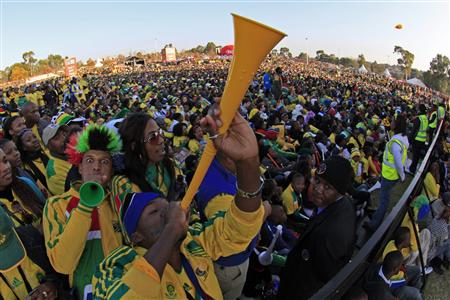
Three games in and I've had it with the Vuvuzela. I know it's the local custom but there are local customs all over the world that I can do without. If this noisemaker had been taken up by German or American fans rather than South African crowds it would be denounced as the tiresome annoyance it is. We had a go with one in the office yesterday and even as a solo instrument it's fearfully loud. I can only imagine what 70,000 of them would sound like. That's only a problem for those people watching in the stadium. I'm speaking on behalf of the TV viewer.

Clearly there's nothing wrong with making a noise in any way you think fit but not if it drowns out the gloriously expressive human noise that is an inescapable element of the experience of all proper sports, and football in particular. The beautiful thing about crowd noise is that it reflects even the tiniest nuance of the play. 30,000 fans chorussing "yessssss" or "refereeeee" or even just gasping is a unique and wonderful noise. If you listen to a lot of football on the radio, as I do, you can tell what's happening before the commentator has told you. The sound of an actual crowd is as varied and powerful and eloquent and moving as the best music. Terrible that we should be robbed of that wonderful human music by a musical instrument.

Wednesday, June 09, 2010

What the New Yorker does and doesn't get about "soccer"

Once every four years in the run up to the World Cup, the New Yorker runs a feature about what it has to call "soccer". These pieces, with their distinctive blend of great respect and polite puzzlement, are something I have come to look forward to. They are generally the best things written about football because they take nothing for granted. After the tournament in France in 1996 the magazine's Paris correspondent, Adam Gopnik, who grew up in Europe, wrote a memorable despatch in which he unpacked his theory that soccer's essentially tragic nature, in which the bad guys (the defenders) generally prevail, made it fundamentally unappealing to Americans who like to see the triumph of the men in the white hats.

This year they've got Hampton Sides to profile the American goalkeeper Tim Howard ahead of the England-USA game this weekend. As usual it's a good read, although it falters slightly when it has to describe the English self image when it comes to football. It says England is (note the giveaway singular) "good but rarely as good as its fanatical supporters believe".

I can imagine how you might get the impression of iron fanaticism if all you read was the copy on special promotional six packs of lager. No true Englishman really believes that the team are that good. In fact, far from believing that other nations have hardly any right to play the game, as the piece implies later on, we are predisposed to think most nations are better at it than we are. It is only when we have been worked upon by our two key industries, the deadly tandem of brewing and media, that we allow ourselves to unleash the fateful lightning of that fragile spark of optimism that flickers in our breast and briefly entertain the idea that we are contenders. Come six o'clock on Saturday night we will be swaggering conquerors. By ten o'clock it will be a different story. What the New Yorker, admirable though it is, doesn't understand is what all the ancient football-playing nations off the world understand. The despair you can handle; it's the hope that does you every time .

Sunday, June 06, 2010

Whose box is this outside my house?

I think this is what they call "street furniture". This has been directly outside my house for the last twenty-two years. At first it seemed something to do with BT. Now it appears to be something to do with cable TV. Apart from the fact that it's pig-ugly and I keep bashing the car door against it what really annoys me is that the front is often left hanging open (as pictured) exposing the wires inside. If I had a vandal's nature I could reach inside, grab a fistful and plunge a load of local TVs in to darkness during "Britain's Got Talent". Years ago I asked the local council if they could do something about it and they said they couldn't, because it was all to do with some Act Of Parliament guaranteeing that you could find one of these abominations at regular intervals down every cabled road in the kingdom. Anybody know if this is true or who I could complain to? And who, apart from the viewers, would I be annoying if I decided to take direct action?

Saturday, June 05, 2010

What Mariella Frostrup and Kristen Stewart meant when they used those words

A few months ago I heard a couple of young women in conversation on the Tube. "He looked liked he was going to rape me but then he turned out to be really sweet," one said to the other. That's been ringing in my head ever since. The entire sweep of human relations reduced to violence at one end and charm at the other. It's the same style that describes things as "really brilliant" or "a bit crap".

I was reminded of that conversation this week when the actress Kristen Stewart had to apologise for likening the experience of being hounded by photographers to "being raped". At the same time the broadcaster Mariella Frostrup had to withdraw her earlier comment about the producers of Radio Four's Today programme being "a bunch of misogynists".

Let's be kind about this and assume that she reached for the word "misogynist", which means a hater of women, when what she should have used was a term indicating the producers had some kind of bias against women. Since there isn't a word that does that she would have had to articulate the actual thought. Kristen Stewart would have been more accurate if she'd said that the targets of paparazzi often looked as if they've been harried or violated. But she didn't.

In our tone deaf public discourse "personalities" reach for explosive words when they want to minutely increase the drama of their often drab conversation. This isn't just because they think it's the only way they'll be heard. It isn't just linguistic imprecision. It also has a crude moral dimension. It's intended to swiftly reduce complex issues to good guys versus bad guys and to clearly associate them with the former group. In that sense it is, to use a popular portmanteau adjective, "uncool".

Thursday, June 03, 2010

I survived the 1950s

This weekend they were celebrating the centenary of Jowett Cars, a company that manufactured cars in Yorkshire between 1910 and the early Fifties. My brother in law took this picture of a Jowett van at one of their events. We think it's the same model that my parents had when I was a small child. One day they put me in my pram, loaded it into the back of the van and then set off to Leeds. On the way round Tingley Roundabout it became apparent that the back doors weren't closed properly. The doors opened and the pram rolled out - with me in it. There wasn't as much traffic then as there is today and, this being the fifties, there was a passing District Nurse who yanked me and the pram out of danger. Doesn't mean I stop thinking about it. Obviously, as is traditionally the case with those isolated incidents of heart-stopping terror that happen when you first become a parent, they never told their parents.

Monday, May 31, 2010

Memories are made of this

The Hungarian violinist Gyorgy Pauk was on "Desert Island Discs". By the time he was four both his parents had disappeared into labour camps, never to return. He said he had no memory of even a kiss from them. It was only when he said this that it struck me just how memorable even the most glancing flesh-on-flesh contacts can be. My parents have been gone a long time but if I close my eyes I can still remember the texture and the smell of my close encounters with them, most of them in early life. I can feel my mother's lips on my cheek and the proud weight of my father's hand on my knee as we travelled to his work. It's somehow more remarkable because I wasn't making any effort to remember at the time. Had I known, of course, I would have been concentrating.

Friday, May 28, 2010

Probably the most educational film of the decade

I'm not saying that "Good Hair" is a film that changed my life but it's certainly a film that will change the way I look at a large part of the population. It's a brilliant documentary made for HBO which comes out here soon on DVD. It's about black women and their relationship with their hair. This relationship, I discover, is a hundred times more complex, expensive and time-consuming than that of their white counterparts. Chris Rock, who presents the film, finds out the staggering lengths that black women will go to in their pursuit of straight, flowing hair. He learns about the wigs that black women formerly wore (this is what Tommy Tucker was urging his baby to put on in "High Heel Sneakers"), the staggering multi-million dollar trade in "relaxants", the creams that temporarily remove the natural kink in "nappy" hair, and then looks at the weaves sported by the superstars and those who aspire to look like them. He travels to India to find out where the hair they wear in Compton and Harlem comes from and he visits the annual hair fair in Atlanta, Georgia where he finds that while African Americans only account for 12% of the US population they're responsible for 80% of the money spend on hair care products. The pain and expense these people are prepared to go to is genuinely astounding. The film can't help touching on all manner of issues - from racial stereotyping through fashion and economics to the rules regarding touching a black woman's hair during sex (the only rule is don't) and the fact that the haircare trade is Asian-owned - and features more engaging, candid and savvy interviewees than you'll see in a whole year of documentaries, partly because it doesn't feature one academic or journalist. You can get a good idea of it here. I can't recommend it too highly.

Tuesday, May 25, 2010

Could paywalls make people nicer?

The Times paywall may have one interesting consequence. People who've paid may be more willing to post their comments on the site. If they're in the company of other people who have made a similar investment they will assume they're less likely to be the victim of a rhetorical drive-by than they might have been in the past. In the last few years, as newspaper sites have been an open prairie, they've been magnets for people who just wanted to unload a few prejudices before moving on and the flagrant lack of respect for other people's right to a view has made you tremble. There's a difference between a debate among Times readers and a forum in which a lot of people have only turned up to bait the paper's core constituency and to make themselves feel better by simply venting.

I note that The Independent have at the same time taken steps to make it easier for posters to use their Facebook or Twitter names. It will be interesting to see how this works. Our experience on The Word site, which is an oasis of civility in the human zoo, is that people prefer to use screen names because that way they don't draw an employer's attention to the fact that they might be posting on the firm's time. However, whether anonymous or not, the posters do seem to accept that the forum they have is worth having and that they have a shared responsibility to maintain it. Is it possible that something similar could happen on a bigger stage?

Monday, May 24, 2010

Who's a wedding present for?

Somebody I know is going to a wedding. Being a wedding guest can be an expensive business. Weddings often involve a party in the evening. This tends to entail an overnight stay. If you're traveling and staying overnight as the head of a grown-up family with plus-ones, as I have in the past, it can cost you the best part of a thousand pounds. Anyway, the wedding that my associate is going to is the wedding of two people who've been living together for a number of years. This means that they already have many of the things that couples getting married traditionally had as wedding gifts. We got a vacuum cleaner and some pans, for instance.

Marrying couples in 2010 already have all the pans and vacuum cleaners they require. Therefore this couple have hinted to some of their friends that they would rather have money. I argue that this wasn't a good idea, not least because their honeymoon is in Las Vegas, which rather suggests that my associate's money could go straight to the house on the first night. It's being suggested that I'm an old skinflint saying that they shouldn't get what they want and it shouldn't make any difference if they want to fritter it. That's their business.

I've been thinking about this. It strikes me that a wedding gift is not like other gifts. It's not actually for "the happy couple". It's supposed to be a contribution to setting people up in life. I remember couples in the past asking for something for their "bottom drawer". This always made me picture crisp new sheets. People accepted that it was perfectly legitimate to ask for things for their bottom drawer. If you were buying things on people's wedding list you weren't just gratifying the desires of the couple. You were contributing to the setting up of a home and by extension a family and, by further extension, society.

Wednesday, May 19, 2010

How to manage The Big Reveal

They've been unveiling the Olympic mascots tonight. Unveiling is a game you can never win. I haven't seen these mascots but I feel sorry for the people who had to do the unveiling and submit to the instant reaction from the web. This is particularly trying on Twitter, where people's fingers are walking long before their brain has arrived at any opinion.

I've spent long hours of my career standing in front of board meetings, investors and other interested parties and I've done everything in my power to avoid the moment of the reveal, whether it's a name, a design or the most nebulous concept. The reveal transfers the power from the people who've done a lot of thinking about the problem to the people who haven't. If the latter group are less than convinced they don't do the sensible thing, which is to reserve judgement; they instantly form themselves into a hanging jury and condemn the solution out of hand.

Two people can make a design decision. One to do and one to comment. Three can manage it if they've got good chemistry. Any number greater than that is asking for trouble. If you're going to do a reveal you should make sure that you've got a handful of key opinion formers on side long before you lift the curtain. The rest will wait a mini-second before uttering an opinion and will fall in behind the tiny minority whose opinion counts.

Monday, May 17, 2010

My weekend away in Newcastle

This weekend I went to Newcastle. I haven't been there for more than twenty years. You tend to follow well-trodden paths as you get older, dictated largely by family, holiday and business. It was only when New Writing North invited me to take part in a panel on "Writing About Music" at the magnificent Sage in Gateshead with a concert by Randy Newman thrown in on the Sunday evening that I had the chance to go.

One of the odder features about this kind of weekend away is the way you bump into people you've known for years (I met Tim de Lisle from Intelligent Life at the Randy Newman concert and we went for a drink at the Crown Posada, a wonderful pub recommended by a Twitter friend), people you think you know because you've heard them so much on the radio (Ian McMillan was the MC of the whole Words and Music event and proved to be an enthusiastic follower of the Word podcast), people you've never met before (I went for an Indian meal with Ivan Hewitt from the Telegraph and we found ourselves alongside a twelve strong party of Indian ladies who were whiling away the time waiting for their food by playing bingo) and a few Word readers who came up to say hello. It was a most civilised way to spend the Sunday afternoon and evening on the banks of the Tyne.

Contrast this with Saturday night when I had one pint in the Crown Posada and then an excellent meal at Oldfields before wandering round the City as the stag and hen parties began to muster. The women were wearing identical tee shirts and pink Deely boppers, the men in shirts and jeans apart from one member in demeaning drag; it all seemed to be driven not so much by hedonism as a weary sense of duty. I turned in early. Given the dimensions of my room not much else was feasible.

Tuesday, May 11, 2010

Eight things I learned at the Sony Awards

To the Sony Awards, there to see eight media truths being acted out.
1. The day of embargoes is past. The Telegraph's media editor had been given a list of the winners, written them up and given it to his production people with strict instructions not to publish before a certain hour. Of course they disregarded his orders and so anyone who really wanted to know if they'd won could look on the web. Inevitable really.
2. The thing we require from presenters is energy. Chris Evans was in charge. He was as good as anybody I've ever seen, pushing all thirty-eight categories along while making sure that the most deserving got their golden moment.
3. As prizewinner David Attenborough observed, compared to radio TV is easy.
4. An audience of radio professionals is better mannered than its inky equivalent.
5. Breakfast show presenters look each other up and down like gunfighters. When Christian O'Connell and Johnny Vaughan came up you could see Evans bristle.
6. People who get paid for introducing pop records on the radio would be well advised to look in the mirror every morning and remind themselves that they have one of life's cushier numbers; we don't need to know about their children.
7. There's something uniquely undignified about being introduced as FHM's "fourth sexiest woman in the world".
8. Everyone over 60 is "legendary".

Monday, May 10, 2010

Is this the election nobody wanted to win?

Halfway through the football season it became a pundit's commonplace to remark that this was the Premiership title that nobody wanted to win. If they wanted it, the argument ran, the main contenders wouldn't be losing so many games.

I feel the same about the election. The three main parties would probably prefer it if this weekend's negotiations could go on and on: Brown because that's his only hope of avoiding oblivion, Clegg because he suddenly has to decide what his party stands for (which will come as unpleasant surprise for at least half the people who voted for them) and Cameron because he knows that Mervyn King wasn't joking when he predicted that whoever forms the next government is doomed to stay out of office for a generation.

Although "the public", whoever they are, make noises about wanting the politicians to come to some agreement in the name of the national interest, they may also wish this cup to pass from them for as long as possible because they appear united in saying what they don't want (Andrew Rawnsley wrote an excellent piece pointing out that "there is both an anti-Conservative majority and an anti-Labour majority in Britain") and rather less willing to face an immediate future which is going to be tougher than anyone reading this blog has ever known.

We've already seen what Greece thinks of it all. This morning on the radio someone was saying that Spain's government is spending double what it takes in on tax revenue. And one poll before the election said that 75% of the British public thought our nearly two hundred billion deficit could be made up on efficiency savings. I wouldn't want to be the person who had to tell them just how wrong they are. Don't be surprised if the politicians keep talking.

Saturday, May 08, 2010

Do they still make shocking beauties like Louise Brooks?

I've been watching some old Louise Brooks films. Hollywood has always been full of gorgeous young women but I don't see many today who have the destabilising beauty of Brooks and a few others (Marlene Dietrich, Myrna Loy, Vivien Leigh) during Hollywood's Golden Age. When you see Brooks on screen its not a figure of speech to say you have to catch your breath, much as you do near the beginning of Rear Window when Grace Kelly's face looms over James Stewart. In fact it's more than beauty. With images like this you can see what Marlowe was getting at when he talked about "the face that launch'd a thousand ships/And burnt the topless towers of Ilium". Scarlett Johansson's very lovely, of course, but, well, she couldn't start a war.

Thursday, May 06, 2010

Come here and say that: do the anonymous deserve a response?

On the day we exercise our right to do the only thing that we really *need* to do anonymously, which is vote, I'm been thinking about how people on the web prefer to remain nameless when they're voicing the sentiments that are clearly closest to their hearts. This is rum if you think about it.

Many of the people who post comments in response to my humble mutterings in this place do so under assumed names. This doesn't bother me much, particularly since they're generally responding in the spirit of the blog. If I could visualise this spirit it would be a community of seals keeping a bright red beach ball in the air. But every now and then the door is opened to admit a gust of arctic air and a person with a grievance, not so much against the post or the poster as against someone or something that this post puts into their mind. And then you have to decide, do I respond openly to somebody who isn't being similarly open?

In the new issue of The Word there's an interview with Rob Manuel of the nerd community B3TAin which he mentions the fact that he is more inclined to let correspondents have their own way than engage in fruitless argument. He likens this process to dealing with his four-year-old in that the diplomatic thing to do is let them have their hollow victory. That's one way of dealing with it. Mark "Mr Geniality" Ellen always writes back to even the most splenetic emails and generally finds that people are instantly mollified by having any kind of response. A subscriber to a magazine is, however, in a privileged position. They've paid their money and are entitled to demand some satisfaction.

It's not the same "out there". When I read many of the "comments" on the web their authors seem to be reaching for a tone of indignation and spite that no actual human being in real life would ever allow themselves to use. Have you ever *read* the comments to even the most anodyne blogs on The Guardian? Aren't these people supposed to be the peacemakers? To judge by the tenor of their comments many of them seem to be sitting atop a volcano of undischarged emotional lava. Maybe they're less interested in getting an answer than just letting it all out. Maybe the act of saying something is more important than its likely effect on anyone else.

Maybe it's all a necessary counterweight to the increasing conformity of the Gap generation. When I go into the average working environment nowadays, particularly the ostensibly "creative" ones, the atmosphere is one of quiet professionalism and a certain conformity. There's no noise, no banter, no larger than life. I often wonder if a couple of feet below the brows furrowed with pleasant concentration their tappety-tappety fingers are sending forth monsters.

Sunday, May 02, 2010

Looking at an old copy of Smash Hits


I just came upon this edition of Smash Hits from 1990. Flicking through it I'm reminded of how difficult it is to keep any kind of perspective on pop, simultaneously the most ephemeral and also the most enduring branch of show business. The cover stars are Elton John and Adamski. Elton was doing one of his periodic blood transfusions in which he sidled up to whoever was the hot new thing and made a record with them. He's done it with George Michael, Eminem, Lady Gaga and probably lots of people, like Adamski, who could walk past you in the street today without being recognised. The intro to the feature feels the need to explain who Elton is. "He's been around for twenty years," it thralls. Well, since then he's been around another twenty, as has Kylie, who's the centrespread. As has Robert Smith who reviews the singles and Morrissey, Pet Shop Boys and George Michael, who all have full-page ads in the issue. There are a few, such as Twenty Four Seven, who were never heard of again, but then I'd probably find that one of them has been writing huge hits for some chartbuster of today. The back cover poster of MC Hammer looks a bit comical as does the New Kids On The Block poster special. But even the featured acts who don't have smash hits any more, such as Sean Ryder and A-ha, still loom large and could probably kick up a little dust if they put a new record out. Jason Donovan is still a big enough name to be starring in a West End musical. Whitney Houston, also featured, has been the centre of a storm quite recently, which proves that her name still means something long after her actual music has run its course. What's that line from Sunset Boulevard? "I'm still a big star. It was just the pictures got small."

Saturday, May 01, 2010

Today I Googled "British Prime MInisters who were not elected" and got this

It was on a forum called Indian Officer. I know it's not accurate and that Winsten Charchil was eventually elected, as was Jhon Major and who knows, the same thing may happen to Garden Brown, but what it does demonstrate, apart from the enduring charms of Indian English, is that in this country it's quite unusual to simply get elected as prime minister. Whereas once you happen to be there or thereabouts when the previous incumbent resigns or gets ill, you can simply move next door and we'll tolerate you.

Friday, April 30, 2010

Who wants the official X Factor magazine?

The producers of X Factor are inviting bids from publishers who would like to publish the official magazine. I understand the fee for the licence is £2,000,000. Amazingly, there are still two companies in the running.

I've always been sceptical about official magazines. Usually by the time they've got round to doling out the official licence then the unofficial publishers have made hay. First time I came across this was around the time that Adam Ant was the biggest thing in British pop. You weren't allowed to publish posters of him because his image was owned, beauty spot and all, by the Merchandising Corporation of America, who sent their lawyers round to make sure you weren't doing anything they didn't make money from. Felix Dennis, who had made at least some of his fortune from unofficial Bruce Lee magazines, instructed a designer to simply shift the beauty spot from one cheek to the other, thereby getting round the image that they had copyrighted.

The other problem with official merchandise is the very fact that it's official, which means that it primarily has to please the people who granted the licence, who know nothing whatsoever about publishing and tend to be over-sensitive. They've usually got wildly unrealistic ideas about the kind of advertising they can get, based on a conversation that somebody had with somebody they were sitting next to in First Class. This is further complicated in this case by the rumour that the producers are looking for a magazine which is weekly during the run of the programme and then monthly thereafter. This would be different. I predict lots of fun and games.

Tuesday, April 27, 2010

Is discovery really the greatest thrill in music?

There's a new music sharing service called mflow. I haven't tried it yet. Its tagline is "Discovery - it’s the greatest thrill in music".

Well, I know why they've said it. I use something along those lines myself. It plays well with advertisers. It's one of those uncontroversial sentiments that goes through on the nod in any company. Everybody likes to think that nothing gets them more thrilled than the prospect of another new group. People with no more than a passing interest in music ask me "what should I be listening to?", which I've decided is the single most dispiriting sentence in the English language. What you should be listening to is whatever makes you happiest. I've no idea what that is unless I've known you for a few years.

I don't think discovery is the greatest thrill in music, not unless you're a night time DJ looking to get the jump on your competitors or an A&R man for a publishing company. I can see how you might get thrilled if you thought that your fortunes would rise in lockstep with the act you've discovered. But the rest of us have got lives to lead, lives that are full enough with work commitments and entertainment options not to be sitting around saying "it's Thursday and I haven't discovered anyone new this week."

And we've already got tons of music to listen to, much of which we hardly know. In fact a lot of it we don't have much interest in. We "discovered" it at some point in the past but then the thrill didn't last very long. The really precious commodity is not "new music". It's our proper attention. This is governed far more by mood and all sorts of things swimming through our lives  – how we're feeling, what we're reading, where we are, who we're with – than it is by the arrival of a previously unheard talent.

I discovered some music recently – the early albums of Cat Stevens. These came out forty years ago. Of course I'd heard them before but I hadn't listened before and I certainly hadn't listened sympathetically, which is the only kind of listening that matters. That's the thing about music. You have to lean towards it. "Discovering" it means that you have to first discover something within yourself.

Sunday, April 25, 2010

You went *how* far for *how* long?

I wonder if the ash cloud business will prove to be one of those quietly pivotal moments. Suddenly we're hit by the dismaying realisation that we have built a world where closing a few airports for less than a week means the economy all but seizes up. I've heard of schools with 17 teachers who were unable to get back into the country. And this isn't even the main holiday period of the year. It's as if the music stopped suddenly in the middle of a holiday and you got a unique opportunity to see how far away so many people had gone for such a short time. Before cheap, easily booked air travel nobody would have considered travelling to certain destinations at all and certainly would have had difficulty understanding the idea of taking a five-day holiday a thousand miles away. Maybe we'll start thinking about it now.

Friday, April 23, 2010

Don't put your daughter in the meeja, Mrs Worthington

At this time of year I get more emails than ever from young people either looking for work experience, sixth formers wondering what A levels they should do if they want to be a star journalist or graduates who are wondering if we have any staff vacancies for young writers ("I am enthusiastic about all kinds of music, movies and contemporary culture, well-motivated and good at working as part of a team". This makes me wonder if they have any sense of what kind of "team" works on a monthly magazine and what they all do.)

It was never easy to know how to respond to this kind of enquiry in the past. Nowadays it's impossible. I turn down requests to address students because I can't think of any experience I could draw upon that might be of any use to a person making a start in the turbulence of today. Other than, are you really too late to think about doing something else? The sort of things you might have told people in the past – start as a freelance contributor, be available for holiday relief and if you're very lucky you might get a staff job - no longer apply. I have a fuzzy sense that young people would be better off if they developed a more entrepreneurial mind set and started aiming beyond the reviews section of the NME but I don't know how to tell them to go about it.

This generation, who have been the victims of "education, education, education" and have grown up being told that they could be anything they wanted to be, are finding that this is anything but the case. Among the twenty somethings I meet there's a palpable sense of betrayal. I wonder if we're seeing the trend of the 80s reversed. During that decade people who'd been prepared for quite mundane jobs and professions found themselves hitching a ride on the economy into an altogether more glamorous milieu. Hardly any of the people I worked with in those days had trained to do the job they ended up doing but there were more jobs than there were good people to fill them. In response to this surge, billions of pounds were then pumped into training people to take their place in Britain's allegedly booming creative economy. Now we find ourselves with all these people being unleashed into the market at the exact point that the creative economy has slammed on the brakes.

We're already starting to see the 80s trend in reverse. The people who have been trained for the glamour jobs are taking whatever there is, no matter how mundane. There's nothing wrong with mundane, of course, unless you've been raised to expect something altogether different.

Wednesday, April 21, 2010

Watch the skies

The thing I can't take seriously about elections is the manifestos. Where else in life do organisations or people come up with a whole booklet detailing all the things they intend to do over the next few years, outlining how their measures (what a silly, misleading word that is) will change things and what's more change things for the better? I can't take it seriously, particularly on a morning where the biggest story of the moment, the planes crisis, wasn't even in anyone's thinking a whole week ago.

If this government had known that its time in office would be dominated by an unprecedented terrorist outrage perpetrated with Stanley knives, an outbreak of foot and mouth disease, a national fit of righteous indignation over MPs expenses, the violent death of an estranged member of the Royal Family and the worst worldwide financial crisis since 1929, to name but a few, or that its last days in office it would be spent dealing with the fact that Middle England was stranded in its holiday resorts because of a volcano in Iceland, I don't think they would have spent quite so long dotting the i's and crossing the t's on their policy plan.

When Harold Macmillan was asked what he feared most in government he said "Events, dear boy, events". In his, relatively slow moving world, events came as single spies. In our connected one they come in battalions. The wise prime minister would say, I'm just going to sit here and wait for events.

Sunday, April 18, 2010

The thing that parenthood really takes out of you

Up early again to enjoy the cloudless, planeless blue sky. A Twitter acquaintance, struggling with small children, envies me being able to sit in the garden with a book and a cup of tea. I assure him that the storyline of parenthood begins with them waking you in the middle of the night, continues with them getting you up early in the morning and then settles into a long period when the only person getting up is you. At that point you might have to wake these lanky young adults for a meal in the middle of the afternoon. In fact there are times when if you didn't intercede they would sleep right round the clock. My Twitter friend says, at least that means he can look forward to some lie-ins in the future. I didn't tell him that the experience of parenthood left me incapable of lying-in. It's one of those things that kids seem to discover the joys of just as you find you can do without it. I didn't want to spoil his day.

Thursday, April 15, 2010

Danny Rose accelerates from nought to myth in a heartbeat

Last night Spurs played Arsenal. It's one of the most charged rivalries in sport, made even more electric by the fact that both teams still had something to play for as well as the usual pride. Both teams were diminished by injury. Spurs picked 19-year-old Danny Rose for his first Premiership start. He hit one of those volleys from a distance that usually disappear into the stand to the accompaniment of jeers. God knows what combination of skill, good fortune, fate, physics and atmospheric pressure brought it about but his shot went in the net. I've seen it probably thirty times since then. It will no doubt be one of the goals of the season. It's now become a TV event rather than a sporting one, its accompanying commentary imprinted on our consciousness. When we watch it we know the precise sequence in which the events will unfold; the commentator's delighted roar, the post-orgasmic run back to accept the adulation, the inevitable feeling that he will be lucky if anything in his life ever equals that one second in which he made contact. This Sky clip may have been removed by the time you get to it.

However another clip probably won't have been taken down because it was shot by a Spurs fan behind the goal on a cameraphone. He captures the same event but without any of the hindsight and narrative tidiness which TV instantly stamps on any bit of experience. It appears to be another attack breaking down - in that respect football is like a game of Jenga played at high speed - and when the ball goes out to Rose (0.35 on this clip) there's no sense of what's about to happen. There's relative silence as he hits it and not much more as the ball travels through the air. The crowd don't realise what's going to happen until it's clear that it has happened. Then the noise rends the air, crashing the phone's limiter and forcing its owner into a chaotic scrum.

It makes we want to have a machine that can undo TV. Imagine if we had the same kind of simple eye witness to the Maradona Hand of God or the Shane Warne Impossible Ball. If only we could take myth and turn it back into just experience.